Bit error rate (BER)
The fraction of received bits that are decoded incorrectly. The fundamental performance metric of any digital optical communication link.
The bit error rate is
A BER of means one in bits is incorrectly decoded: roughly one error per second on a 1 Gb/s link, or one error every 100 ms on a 10 Gb/s link.
Telecom reference points:
| BER | Notes |
|---|---|
| About | Pre-FEC threshold of soft-decision FEC with 20 to 25% overhead (coherent systems) |
| Pre-FEC threshold of 7% hard-decision FEC | |
| Pre-FEC threshold of the KP4 Reed-Solomon code in Ethernet | |
| Historical "error-free" specification for direct-detection systems | |
| Modern "error-free" specification for unFEC'd telecom systems | |
| Post-FEC specification for telecom systems (after forward error correction) |
For Gaussian noise on a binary signal (NRZ OOK), BER relates to the Q-factor of the eye:
where is the ratio of eye opening to total noise spread (note: this is the receiver-Q, distinct from resonator Q factor). corresponds to BER ; to BER .
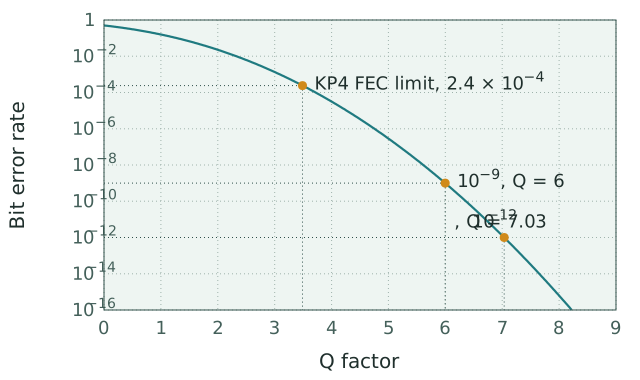
Computed from for Gaussian noise. Each step of one in Q near the bottom of the curve buys about three decades of BER.
The conversion is worth having as a table, because link budgets are kept in dB and is the electrical SNR margin that a given BER requires:
| BER | ||
|---|---|---|
| 2.33 | 7.3 dB | |
| 3.09 | 9.8 dB | |
| (KP4 pre-FEC threshold) | 3.49 | 10.9 dB |
| 3.72 | 11.4 dB | |
| 4.75 | 13.5 dB | |
| 6.00 | 15.6 dB | |
| 7.03 | 16.9 dB | |
| 7.94 | 18.0 dB |
The table is the arithmetic behind forward error correction. A link that must deliver uncorrected needs ; a link that only has to deliver into a KP4 decoder needs , which is 6.1 dB less electrical SNR, and the decoder makes up the difference. Modern short-reach receiver sensitivities and the TDECQ metric are all defined at the pre-FEC threshold for this reason; for PAM4 with Gray coding the corresponding symbol error ratio is , twice the bit error ratio, because most symbol errors flip one of the two bits.
For coherent modulation formats, the relationship between BER and required OSNR depends on the constellation and scales with the symbol rate. Theoretical values for dual-polarization signals at 32 GBaud in white Gaussian noise:
| Format | Required OSNR (at BER, 0.1 nm) |
|---|---|
| DP-BPSK | 10.9 dB |
| DP-QPSK | 13.9 dB |
| DP-16QAM | 20.6 dB |
| DP-64QAM | 26.6 dB |
Each doubling of the symbol rate adds 3 dB, and real transceivers add an implementation penalty; the QAM entry gives the corresponding figures at the soft-decision FEC threshold.
Measurement: BER is measured by a bit error rate tester (BERT) that transmits a known pseudo-random binary sequence and counts decoder errors. Confident measurement to BER requires bits. That is about 17 minutes at 10 Gb/s, or 25 seconds at 400 Gb/s.
Modern forward error correction (FEC) is the central enabler of high-speed coherent transmission: a soft-decision code with 20 to 25% overhead takes a pre-FEC BER of about to an output BER below . Reaching without coding would need 11.7 dB more SNR for QPSK; the code's overhead costs about 1 dB of that back, leaving a net coding gain near 11 dB.
The pre-FEC threshold in the context of a whole 100G link is shown in Bits to Light.