Spatial hole burning
Local depletion of gain where the optical field is strongest, leaving unburned gain elsewhere for competing modes. The mechanism behind many LIV kinks, multimode onsets, and high-power DFB instabilities.
Spatial hole burning (SHB) is gain saturation that varies from place to place in the cavity. A lasing mode is not equally bright everywhere, so stimulated emission depletes the carriers most where its intensity is highest and leaves more gain where it is weak. A competing mode whose intensity lies mainly in the regions of left-over gain then sees more gain than it would in a uniformly saturated medium and can reach threshold, and the laser's output power, beam or spectrum changes at that point. In semiconductor lasers hole burning acts on three length scales, with different consequences: the standing wave, the envelope of the mode along the cavity, and its profile across the stripe.
Standing-wave scale
The forward and backward waves in the cavity form a standing wave with a period of , 228 nm at 1550 nm for an index of 3.4, and would burn a grating of the same period into the carrier density. Carrier diffusion smooths it out: for an ambipolar diffusion length the depth of such a grating is reduced by the factor , which is about 760 for = 1 µm and 3,000 for 2 µm. The standing-wave hole burning that makes standing-wave solid-state lasers run on several longitudinal modes therefore has little effect in edge-emitting diode lasers. In VCSELs, whose quantum wells sit at fixed positions in the standing wave, the axial pattern matters more.
Longitudinal scale in DFB lasers
Diffusion cannot flatten variations over hundreds of micrometers. In a DFB laser the grating shapes the intensity along the cavity, and how much depends on the coupling strength . Computed with coupled-wave theory for a quarter-wave-shifted grating with anti-reflection-coated facets, at threshold:
| Threshold gain, | Intensity at center / at facets | Largest / smallest intensity | |
|---|---|---|---|
| 0.5 | 4.88 | 0.20 | 5.0 |
| 1.0 | 3.05 | 0.66 | 1.8 |
| 1.25 | 2.49 | 1.01 | 1.4 |
| 1.5 | 2.04 | 1.47 | 1.8 |
| 2.0 | 1.39 | 2.87 | 3.0 |
| 3.0 | 0.66 | 9.14 | 9.2 |
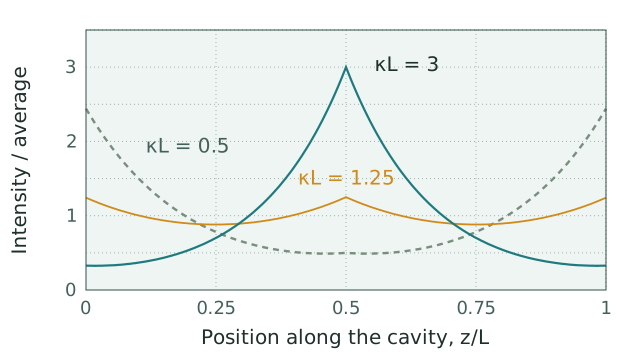
Intensity along a quarter-wave-shifted DFB laser with anti-reflection-coated facets at threshold, computed with coupled-wave theory and normalized to its average over the cavity. A weak grating leaves the light brightest at the facets; a strong one concentrates it at the phase shift in the center, nine times the facet intensity for ; keeps it within a factor of 1.4.
The threshold gain is the modal power gain, beyond the internal loss, needed to make up for the light leaving through the ends. A strong grating lowers the threshold but concentrates the light at the center: at the center is nine times brighter than the facets. As the power rises the carrier density at the center falls below that at the ends, and through the carrier dependence of the refractive index, the coupling that the linewidth enhancement factor describes, the effective index at the center rises. The grating is then detuned locally, the mode changes shape, and the gain margin over the side modes shrinks; the side-mode suppression ratio falls, the wavelength shifts, and at some current the mode may reorganize, with a kink in the L–I curve and sometimes a mode hop. The intensity is most even near , where the center and the facets are equally bright and the intensity varies by a factor of 1.4 along the cavity, the condition identified by Soda and colleagues. Lasers for high power keep near that value or use gratings with several phase shifts or a varying period to flatten the intensity further.
Lateral scale
Across the stripe of a ridge or broad-area laser, the fundamental lateral mode is brightest at the center, so the center is depleted first. The carrier profile left behind, higher at the edges, raises the gain seen by higher-order lateral modes and, through the carrier-dependent index, forms a lens that reshapes the modes themselves. As the current rises the consequences appear in sequence: broadening of the far field, steering of the beam, the onset of a higher-order lateral mode and, in broad-area lasers, filamentation. The power up to which a laser stays in its fundamental lateral mode, specified as its kink-free power, is set largely by lateral hole burning.
Spatial and spectral hole burning
Spatial hole burning is distinct from spectral hole burning, the depletion of carriers at particular energies within the gain spectrum, which in semiconductors recovers in less than a picosecond and contributes to gain compression, and in inhomogeneously broadened media persists on all time scales. The two share the logic of local saturation but act on different coordinates, position and energy, with different physics and time scales.
How it shows up
Several separate measurements can show one redistribution of carriers: a kink in the L–I curve, a change in the far field at the same current, a dip in the side-mode suppression ratio, or a step in the wavelength. Their coincidence at one current points to hole burning. The LIV kink entry covers the diagnosis, and Why laser diode L-I curves kink explains the lateral mechanism behind most beam-steering kinks.
Common questions
What is spatial hole burning?
The uneven depletion of gain in a laser, strongest where the lasing mode is brightest. It leaves gain in the places where the mode is weak, where a competing mode can use it.
Why does spatial hole burning cause multimode operation?
Because the lasing mode can no longer use the gain left where it is weak, while a mode with a different intensity pattern can. When that mode's gain reaches the cavity loss it starts to lase alongside the first.
How does spatial hole burning affect DFB lasers?
A strongly coupled grating concentrates the light at the center of the cavity, nine times the facet intensity for , so the center saturates first. The resulting change of refractive index along the cavity detunes the grating and lowers the side-mode suppression at high power. A coupling strength near gives the most even intensity.
What is the difference between spatial and spectral hole burning?
Spatial hole burning depletes the gain at particular positions in the cavity; spectral hole burning depletes it at particular photon energies. In semiconductor lasers the first follows the carrier density, on time scales of nanoseconds, and shapes the modes and their stability, while the second recovers in under a picosecond and appears as gain compression.
References: H. Kogelnik and C. V. Shank, "Coupled-wave theory of distributed feedback lasers," Journal of Applied Physics 43, 2327 (1972). H. Soda, Y. Kotaki, H. Sudo, H. Ishikawa, S. Yamakoshi, and H. Imai, "Stability in single longitudinal mode operation in GaInAsP/InP phase-adjusted DFB lasers," IEEE Journal of Quantum Electronics 23, 804 (1987). L. A. Coldren, S. W. Corzine, and M. L. Mašanović, Diode Lasers and Photonic Integrated Circuits, 2nd ed. (Wiley, 2012).