Laser threshold
The pump power or injection current at which optical gain equals cavity loss and stimulated emission becomes self-sustaining. Below threshold the laser emits spontaneous emission only; above threshold, coherent stimulated emission dominates.
The laser threshold is the pump level at which the optical gain of the gain medium exactly makes up for the losses of the cavity over a round trip, so that stimulated emission in the lasing mode sustains itself. Below threshold the light in the cavity comes from spontaneous emission, weak and spectrally broad, with some amplification near threshold; above it the output rises steeply, collapses into one or a few cavity modes and becomes coherent. For an optically pumped laser the threshold is a pump power, for a diode laser a drive current, the threshold current, and for a gas laser a discharge current.
The threshold condition
Light making a round trip through a cavity of length is multiplied by the mirror reflectances and and by the net gain along the way. At threshold the product is one:
where is the threshold gain coefficient, the internal loss, the fraction of the mode that overlaps the gain (1 for a bulk crystal that fills the beam, a few percent for a quantum well) and the last term the mirror loss . If the gain medium fills only part of the cavity, in the gain term becomes twice the medium's length. The phase must also return to itself after a round trip, which selects the frequencies of the longitudinal modes; the mode nearest the gain peak reaches threshold first.
For a laser transition of emission cross section , the gain is , so the condition fixes the population inversion needed. For a 1 cm Nd:YAG rod ( cm²) between a full reflector and a 95% output coupler, with internal loss neglected, = 0.0256 cm⁻¹ and cm⁻³, 0.066% of the Nd ions in a 1% doped crystal. In a four-level laser such as this one the lower level is nearly empty and a small excited population suffices; in a three-level laser such as ruby more than half the ions must be excited before any gain appears, and the threshold is correspondingly higher.
Above threshold: clamping
Once the gain reaches the loss it cannot rise further in steady state, since a larger gain would make the intracavity power grow without bound. The inversion, or the carrier density in a diode, therefore stays clamped at its threshold value, and the pump beyond threshold goes into stimulated emission in the lasing mode. The output grows linearly with the excess pump,
at the slope efficiency , which gives the light-versus-pump curve its knee. Clamping is exact only for the average gain: spatial hole burning and gain compression let the gain profile change slightly above threshold, which is one reason other modes can start to lase at higher pump.
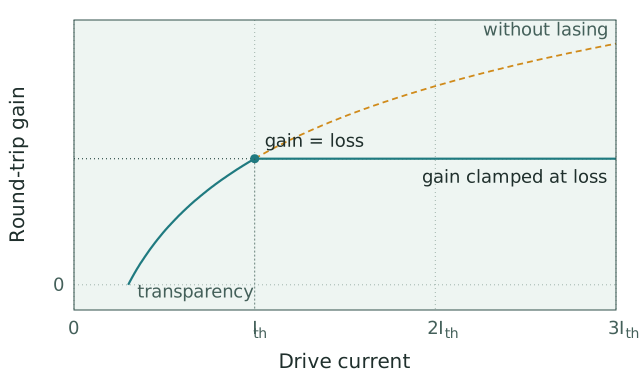
Schematic: the gain rises with drive current until it equals the round-trip loss at . Above threshold the stimulated emission holds it at the loss (solid), instead of the higher value it would reach without lasing (dashed).
What changes at threshold
The transition is sharp but not discontinuous. Its width is set by the spontaneous emission factor , the fraction of spontaneous emission that enters the lasing mode. In the rate-equation model the average number of photons in the lasing mode stays below one well below threshold, reaches at threshold and grows in proportion to above it, so on a logarithmic plot the two straight branches of the output curve are separated by a factor of : to for an edge-emitting diode laser, much less for a microcavity laser, whose threshold is correspondingly hard to locate. At the same time the spectrum narrows from the spontaneous emission band to the lasing modes, the linewidth of each mode falls inversely with the output power (Schawlow-Townes linewidth), and the photon-number statistics of the light change from those of thermal light to the Poisson statistics of coherent light (photon statistics), which Arecchi measured in 1965.
Threshold pump power
For a four-level laser pumped along its axis, the pump must replace the upper-level population that decays spontaneously at the rate throughout the mode. With Gaussian pump and laser beams of radii and , the threshold pump power is (Svelto)
where is the logarithmic loss per pass, plus the internal loss, the pump efficiency, the pump photon energy and the upper-state lifetime. For the Nd:YAG example above, with 100 µm beam radii, 808 nm pumping, = 230 µs and = 0.8, the threshold is 38 mW. The formula shows what lowers a threshold: a small mode area, low loss, and a large product . Ti:sapphire has a cross section of the same order as Nd:YAG but an upper-state lifetime of 3.2 µs, 72 times shorter, which is one reason Ti:sapphire lasers are pumped with watts of green light. Fiber lasers confine the mode to a small core over a length that absorbs the pump completely, and reach threshold at low pump powers. Quasi-three-level media such as Yb:YAG must in addition be pumped hard enough to bleach the absorption of their thermally populated lower level.
Diode lasers
A semiconductor laser's threshold is a current: below a milliampere for a small VCSEL, several milliamperes for a telecom ridge laser and hundreds of milliamperes for a broad-area pump laser, set by the threshold current density and the pumped area. It rises exponentially with temperature through the characteristic temperature, and because the transition is smooth, the value extracted from a measured curve depends on the method used; the threshold current entry covers these points and Threshold extraction methods compares the methods on one data set. Diode lasers are usually biased above threshold for modulation, since a laser driven up from below threshold must first build up its carrier density, which delays the light pulse and excites relaxation oscillations.
Output coupling and threshold
Raising the transmission of the output coupler raises the threshold, because it adds loss, but it also raises the fraction of the intracavity power that leaves as useful output. For a given pump power the output is therefore largest at an intermediate transmission, lower for a weakly pumped laser, whose threshold dominates, and higher for one pumped far above threshold (Rigrod). Low-threshold designs, such as microcavity lasers, use highly reflecting mirrors; high-power lasers use larger output coupling and accept a higher threshold.
Common questions
What is laser threshold?
The pump power or drive current at which the gain of the laser medium equals the losses of the cavity, so that stimulated emission sustains itself. Below it the output is weak spontaneous emission; above it the output rises steeply and linearly with pump and becomes coherent laser light.
What is the threshold condition of a laser?
That the light returns to its starting intensity after a round trip: , or equivalently that the modal gain equals the internal loss plus the mirror loss, .
What happens to the gain above threshold?
It stays clamped at its threshold value. Additional pump power no longer raises the inversion; it is converted into stimulated emission, so the output grows linearly with the pump at the slope efficiency.
What determines the threshold pump power?
The loss, the mode area, the emission cross section and the upper-state lifetime: grows with the loss and the mode area and falls as rises. A diode-pumped Nd:YAG laser with a 100 µm mode radius and a 5% output coupler reaches threshold at a few tens of milliwatts.
What is the difference between laser threshold and threshold current?
The laser threshold is the general condition, gain equal to loss, for any laser. The threshold current is that condition expressed as the drive current of a semiconductor laser.
References: A. E. Siegman, Lasers (University Science Books, 1986). O. Svelto, Principles of Lasers, 5th ed. (Springer, 2010). B. E. A. Saleh and M. C. Teich, Fundamentals of Photonics, 3rd ed. (Wiley, 2019). W. Koechner, Solid-State Laser Engineering, 6th ed. (Springer, 2006). L. A. Coldren, S. W. Corzine and M. L. Mašanović, Diode Lasers and Photonic Integrated Circuits, 2nd ed. (Wiley, 2012). W. W. Rigrod, "Saturation effects in high-gain lasers," Journal of Applied Physics 36, 2487 (1965). F. T. Arecchi, "Measurement of the statistical distribution of Gaussian and laser sources," Physical Review Letters 15, 912 (1965). P. F. Moulton, "Spectroscopic and laser characteristics of Ti:Al₂O₃," Journal of the Optical Society of America B 3, 125 (1986).