Threshold current (laser diode)
The drive current at which a laser diode's optical gain first balances its cavity losses and lasing begins. Below it the diode emits spontaneous light like an LED; above it the output rises steeply and nearly linearly. It scales with the active area, depends on the internal and mirror losses, rises exponentially with temperature, and ranges from under a milliampere in small VCSELs to hundreds of milliamperes in broad-area and quantum cascade lasers.
The threshold current of a laser diode is the drive current at which the optical gain of its active region first balances the losses of its cavity, so that stimulated emission sustains itself. Below threshold the diode emits weak, broadband spontaneous emission, like an LED. Above it the carrier density stops rising, each additional electron adds to the laser output instead, and the power grows nearly linearly with current at the slope efficiency, which gives the L-I curve its knee. The threshold is the current spent before any of it becomes laser light, so it sets the floor of the drive current, part of the heat and the efficiency at low power. The general condition, for every kind of laser, is described under laser threshold.
The threshold condition
Lasing starts when the modal gain equals the internal loss plus the mirror loss , which for a cavity of length with facet reflectances and gives
where is the confinement factor. The gain fixes the carrier density needed, and the current must supply the carriers that recombine at that density in the active volume :
with the injection efficiency and , and the coefficients of defect, radiative and Auger recombination. Because the gain of a quantum well grows roughly as the logarithm of the carrier density, the threshold current density rises exponentially with the total loss, , and approaches the transparency current density as the losses fall (threshold current density).
The mirror loss shows how the cavity enters. Cleaved facets on a semiconductor reflect about 30%, so a 300 µm cavity with two cleaved facets has a mirror loss of 40 cm⁻¹; a high-reflection coating of 90% on the back facet lowers it to 22 cm⁻¹, and doubling the length to 600 µm halves it to 20 cm⁻¹ while doubling the area that must be pumped. Short devices are therefore limited by mirror loss and long ones by their area, and a VCSEL, whose gain region is only a few quantum wells thick, reaches threshold only because its Bragg mirrors reflect more than 99%.
Typical values
Since area, the threshold follows from the threshold current density and the size of the pumped region. Computed from room-temperature ranges of (threshold current density, quantum cascade laser) for common geometries:
| Laser | Pumped area | ||
|---|---|---|---|
| 850 nm VCSEL, 6 µm oxide aperture | 28 µm² | about 2 kA/cm² | 0.57 mA |
| 1310 nm InGaAsP multi-quantum-well ridge laser, 2 µm × 300 µm | 600 µm² | 0.6 – 1.2 kA/cm² | 3.6 – 7.2 mA |
| 1550 nm InGaAsP multi-quantum-well ridge laser, 2 µm × 300 µm | 600 µm² | 0.8 – 1.5 kA/cm² | 4.8 – 9.0 mA |
| 980 nm InGaAs broad-area pump laser, 100 µm × 4 mm | 0.4 mm² | 60 – 150 A/cm² | 0.24 – 0.60 A |
| Mid-infrared quantum cascade laser, 10 µm × 3 mm | 0.03 mm² | 0.5 – 2 kA/cm² | 0.15 – 0.6 A |
Real ridge lasers need somewhat more than the ridge area suggests, because current spreads beyond the ridge and some carriers leak over the barriers, and telecom DFB lasers are typically specified at 5 to 20 mA.
Temperature
The threshold rises with temperature, because the carriers spread over more energy states, Auger recombination grows and carriers escape from the wells. The rise is described by the empirical characteristic temperature :
is 50 to 70 K for InGaAsP lasers, 70 to 90 K for AlGaInAs, and 100 to 160 K for GaAs-based lasers. With = 60 K, the threshold grows by 40% for a 20 K rise and by a factor of 2.7 between 25 and 85 °C; the T0 calculator extracts from thresholds measured at several temperatures. A VCSEL departs from the exponential law: its threshold is lowest near the temperature at which the gain peak crosses the cavity resonance and rises on both sides of it.
Extracting it from an L-I curve
A laser diode has no mathematically sharp threshold. Its output bends from the spontaneous regime to the stimulated one over a range of currents whose width is set by the spontaneous emission factor, and each extraction method places the threshold at a different point in that range:
- Linear extrapolation or two-segment fit. A straight line fitted above threshold is extended to zero power, or intersected with a line fitted below threshold; the intercept is the threshold.
- Second-derivative peak. The threshold is the current at the maximum of , the sharpest point of the knee. It is well defined but amplifies noise.
- Logarithmic derivative. The threshold is the current at the maximum of , which suits broad transitions but needs a positive signal below threshold.
- Fixed output power. The threshold is the current at a stated reference power, which is simple but depends on the reference chosen.
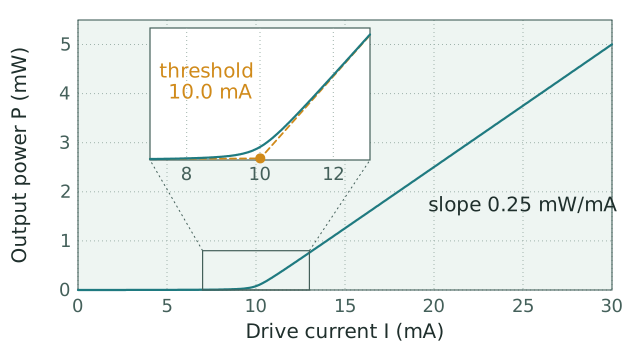
L-I curve from the steady-state rate equations with a nominal threshold of 10 mA, a slope efficiency of 0.25 mW/mA and a spontaneous-emission factor , large enough to make the knee visible. In the inset (7 to 13 mA, 0 to 0.8 mW), lines fitted over 2 to 8 mA and 15 to 30 mA cross at 10.0 mA; the peak of falls at 9.98 mA. On noise-free data the two methods agree to 0.3 %.
On a clean curve from an edge-emitting laser the first three methods agree closely, while lasers with a large spontaneous emission factor, such as microcavity lasers, spread them apart. Values are comparable only when extracted the same way, and the method belongs with the number; Threshold extraction methods applies all four to one data set.
Aging
A laser diode wears out through the growth of non-radiative defects, facet degradation and changes in the contacts and solder, and the visible symptoms are a rising threshold, a falling slope efficiency and, under constant-power control, a rising drive current. Lifetime tests declare failure at a stated change, such as a 20% rise in threshold or a 20% or 50% rise in the operating current needed for rated power, and a lifetime figure means little without its criterion (laser diode lifetime and derating).
Common questions
What is the threshold current of a laser diode?
The drive current at which the optical gain in the laser cavity first equals the cavity losses, so that stimulated emission sustains itself. Below it the diode emits weak spontaneous light like an LED; above it the output rises nearly linearly with current and the spectrum narrows to the laser line.
What determines the threshold current?
The area of the pumped region, the carrier density needed to reach the threshold gain, and the recombination rate at that density. Lower internal and mirror losses lower the gain required, a smaller active region needs fewer carriers, and a higher temperature raises the threshold through the characteristic temperature .
What is a typical threshold current?
From below 1 mA to a few milliamperes for a VCSEL, about 5 to 20 mA for a telecom DFB laser, and a few hundred milliamperes for a broad-area pump laser or a quantum cascade laser.
How does threshold current depend on temperature?
Exponentially, with . An InGaAsP laser with = 60 K needs 2.7 times its room-temperature threshold at 85 °C, while GaAs-based lasers, with above 100 K, change less.
How is threshold current measured?
From the L-I curve: the current is swept, the output power recorded, and the threshold extracted by linear extrapolation, a two-segment fit, the peak of the second derivative or the peak of the logarithmic derivative. The methods differ slightly on the same curve, so the method is stated with the value.
References: L. A. Coldren, S. W. Corzine and M. L. Mašanović, Diode Lasers and Photonic Integrated Circuits, 2nd ed. (Wiley, 2012). J. Piprek, Semiconductor Optoelectronic Devices: Introduction to Physics and Simulation (Academic Press, 2003). G. P. Agrawal and N. K. Dutta, Semiconductor Lasers, 2nd ed. (Van Nostrand Reinhold, 1993). R. Michalzik (ed.), VCSELs: Fundamentals, Technology and Applications of Vertical-Cavity Surface-Emitting Lasers (Springer, 2013).