Output coupler
The partly transmitting cavity mirror through which a laser's output leaves the resonator. Its transmission trades threshold against the share of power extracted, and an optimum value, about 3.5% for a round-trip gain of 0.2 and 1% internal loss, maximizes the output.
An output coupler is the partly transmitting mirror through which a laser's beam leaves the cavity, while the other mirror reflects as much of the light as it can. Its transmission is a central design choice: a larger raises the threshold but sends a larger share of the generated power out of the cavity, and between the two lies an optimum. For a laser with a round-trip small-signal gain of 0.2 and 1% round-trip internal loss, the output is greatest at = 3.5%. Cleaved diode-laser facets reflect about 31%, helium-neon output couplers about 99%, and the output mirror of a VCSEL 99.5% or more.
Reflectivity, threshold and output
With an output coupler of reflectivity , a high reflector and a gain medium of length :
- Threshold gain: , the internal loss plus the mirror loss . Lowering raises the threshold.
- Extraction efficiency: , the share of the light generated above threshold that leaves through the mirrors rather than being absorbed inside. Raising the mirror loss raises it.
- Circulating power: the output is times the power striking the output coupler, so at a given output a small means a large intracavity power.
- Slope efficiency: in a diode laser , with the internal quantum efficiency.
Optimum output coupling
For a homogeneously broadened laser with small gain and losses, Rigrod's analysis gives the output as proportional to , where is the round-trip small-signal gain and the round-trip internal loss. Setting the derivative to zero gives the transmission that maximizes the output:
For () and , = 3.5%, a reflectivity of 96.5%. The optimum grows with the gain. With rising loss it first grows too, up to , and then falls; the laser stops when reaches .
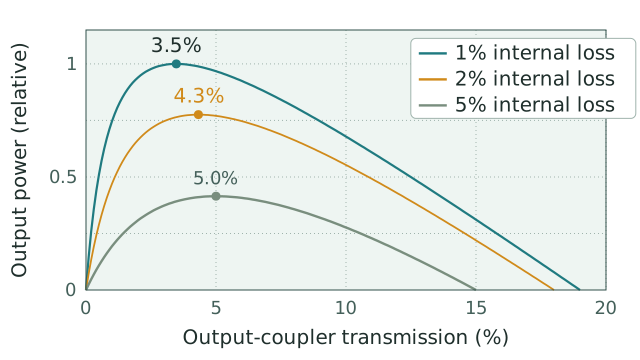
Output against output-coupler transmission from the low-loss form of Rigrod's analysis, for and round-trip internal losses of 1%, 2% and 5%, relative to the highest output. Dots mark the optima. Near each one the curve is flat: with 1% loss, transmissions of 2.5% and 5% both give more than 96% of the maximum.
The broad maximum makes the choice forgiving in the output it gives but not in what else it sets: a lower transmission than the optimum raises the circulating power, which matters for intracavity frequency conversion and for coating damage, and a higher one raises the threshold and the pump power at which the laser starts.
Output couplers in diode lasers
Most edge-emitting Fabry-Perot diode lasers use their cleaved facets as both mirrors. The Fresnel reflectivity of a facet with an effective index of 3.5 is = 31%, and a 300 µm chip with two such facets has a mirror loss of 39 cm⁻¹. Light leaves both ends equally. Coating the facets changes the balance:
| Facets | Use |
|---|---|
| Both cleaved, about 31% each | Equal output from both ends; no coating step |
| High-reflection back, cleaved front | Nearly all the output from the front, at a lower threshold |
| High-reflection back, low-reflection front | High-power lasers, which want a large mirror loss and a low facet intensity |
| High-reflection back, anti-reflection front | External-cavity lasers, where an external mirror or grating takes over as the output coupler |
The mirror loss, slope efficiency and front-to-back split for given reflectivities are worked with numbers in Facet coatings and what they do to a laser diode. In DFB lasers the grating provides the feedback, and the facets are usually anti-reflection coated to suppress Fabry-Perot resonances.
Output couplers in VCSELs
A VCSEL's few quantum wells amplify the light by only about 1% per pass, so both of its mirrors, distributed Bragg reflectors, must reflect more than 99%. The output mirror reflects 99.5% or more, about 18 pairs of AlGaAs layers with abrupt interfaces, and the rear mirror 99.9% or more; the slightly lower reflectivity of the output mirror makes the light leave through it.
Output couplers in fiber lasers
- Cleaved fiber end: the Fresnel reflection of silica ( = 1.45) is 3.4%, enough for a high-gain fiber laser.
- Fiber Bragg grating: written into the fiber, with a reflectivity chosen in manufacture, and reflecting only a narrow band, so it sets the wavelength as well.
- Fiber loop mirror: a fiber coupler with its two output ports joined in a loop reflects of the light for a coupling ratio , all of it for a 50:50 coupler and less for any other ratio.
Heating and damage
The output coupler transmits the full output power, and its coating and substrate absorb a little of it, enough at high power to form a thermal lens. In pulsed lasers the limit is often the coating's damage threshold at the circulating fluence, which exceeds the output fluence by the factor .
Variable output coupling
- Waveplate and polarizer: inside the cavity they eject an adjustable fraction of the light, set by the angle of the waveplate, and act as an output coupler of variable transmission.
- Cavity dumping: an acousto-optic or electro-optic switch keeps the cavity closed while the power builds up and then deflects most or all of it out at once, as a short pulse.
Common questions
What is an output coupler in a laser?
The partly transmitting cavity mirror through which the laser beam leaves. It reflects most of the light back to sustain oscillation and transmits a fraction as the output.
What reflectivity should an output coupler have?
The value that maximizes output depends on the gain and the internal loss: , 3.5% for a round-trip gain of 0.2 and 1% loss. High-gain lasers use low reflectivities, such as the 31% of a cleaved diode facet; low-gain lasers need high ones, such as the 99% of a helium-neon laser.
What happens if the output coupler transmits too much or too little?
Too little, and most of the generated light is absorbed inside the cavity by its internal loss while the circulating power climbs. Too much, and the threshold rises until the laser stops lasing, when plus the internal loss equals the round-trip gain.
Why does the output coupler reflectivity affect slope efficiency?
The slope efficiency is proportional to , the share of the light generated above threshold that leaves through the mirrors. A lower reflectivity raises the mirror loss and with it this share, at the cost of a higher threshold.
References: Saleh and Teich, Fundamentals of Photonics (3rd ed., Wiley, 2019), on laser oscillation; Siegman, Lasers (University Science Books, 1986), ch. 12 (Rigrod analysis, optimum coupling); W. W. Rigrod, "Saturation effects in high-gain lasers," J. Appl. Phys. 36, 2487 (1965); Coldren, Corzine and Mašanović, Diode Lasers and Photonic Integrated Circuits (2nd ed., Wiley, 2012), ch. 2 and 3; Koechner, Solid-State Laser Engineering (6th ed., Springer, 2006).