Optical density (OD)
A logarithmic measure of attenuation, OD = −log₁₀(T), where T is the transmittance. Each unit is a factor of ten, so OD 3 transmits 0.1%, and the attenuation in decibels is ten times the OD. The standard specification for neutral-density filters, filter blocking and laser eyewear.
Optical density (OD) is a logarithmic measure of how strongly a filter or sample attenuates light: the base-10 logarithm of the ratio of incident to transmitted power,
where is the transmittance. Each unit of OD is a factor of ten: OD 1 transmits 10%, OD 3 transmits 0.1% and OD 6 one part in a million. A decibel is a tenth of a factor-of-ten step in power, so the attenuation in dB is exactly ten times the OD. Optical density is the usual specification for neutral-density filters, for the blocking band of notch and edge filters, and for laser safety eyewear; in chemistry the same quantity is called absorbance and is the basis of the Beer-Lambert law.
OD, transmission and decibels
| OD | Transmission | Attenuation | Attenuation factor |
|---|---|---|---|
| 0.1 | 79.4% | 1 dB | 1.26 |
| 0.3 | 50.1% | 3 dB | 2.0 |
| 0.5 | 31.6% | 5 dB | 3.16 |
| 1 | 10% | 10 dB | 10 |
| 2 | 1% | 20 dB | 100 |
| 3 | 0.1% | 30 dB | 1,000 |
| 4 | 0.01% | 40 dB | |
| 5 | 0.001% | 50 dB | |
| 6 | 0.0001% | 60 dB | |
| 8 | % | 80 dB |
Optical densities of filters in series add, so an OD 1 filter and an OD 2 filter together give OD 3, provided the reflections between them are negligible; tilting one filter slightly keeps its reflection from bouncing back through the other. The same arithmetic converts to fiber units: a telecom fiber with a loss of 0.2 dB/km has an optical density of 0.02 per kilometer, and 100 km of it an OD of 2. The Optical Density Calculator converts between optical density, transmission, decibels and attenuation factor, adds up a stack of filters and finds the density needed to bring a beam down to a target power.
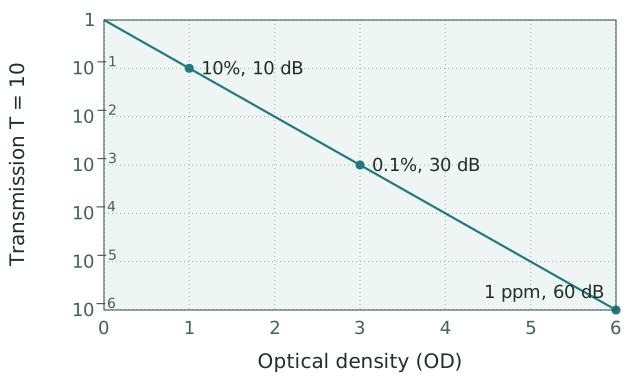
: each unit of optical density divides the transmission by ten, which is 10 dB.
Neutral-density filters
A neutral-density (ND) filter attenuates by a nearly equal factor across a wavelength band, and is named by its optical density: an ND 2.0 filter transmits 1%. Two constructions are common:
- Absorptive filters are colored glass that absorbs the light in its bulk. Their attenuation depends little on the angle of incidence, but the glass heats up in a powerful beam, and the OD changes with wavelength outside the band over which the filter is specified.
- Reflective filters carry a thin metal film that reflects most of the rejected light. They are flatter over a wide band, but the reflected beam has to be directed away from the laser and the rest of the setup, usually by tilting the filter a few degrees.
The nominal OD of either kind holds at one wavelength or over a stated band, with a tolerance; at other wavelengths it can be quite different. Photographic ND filters are often labeled by their attenuation factor instead: ND2, ND4 and ND8 are OD 0.3, 0.6 and 0.9, which are one, two and three photographic stops.
Absorbance and the Beer-Lambert law
In chemistry the same logarithm is the absorbance, , and IUPAC recommends that name over "optical density". For a dilute solution it is proportional to the concentration and the path length ,
with the molar absorptivity in L mol⁻¹ cm⁻¹. A compound with L mol⁻¹ cm⁻¹ at a concentration of 0.1 mM has an absorbance of 1 in a 1 cm cuvette. The optical density of a sample of thickness converts to the natural-log absorption coefficient as , and to a loss in dB per unit length as .
The proportionality holds for dilute samples that absorb without scattering, measured with light much narrower than the absorption band. Very weak absorbers are measured in longer cells, since an absorbance of 0.01 in a 1 cm cell becomes 0.1 in a 10 cm cell. Strong ones run into the instrument's floor: in a spectrophotometer, stray light reaching the detector limits reliable readings to an OD of about 3 to 4, as explained in Measuring optical density beyond the stray-light floor.
Scattering samples and OD600
Optical density is often used in the broader sense of total attenuation, counting light lost to scattering and reflection as well as absorption; IUPAC's name for that total is attenuance. The best-known case is OD600 in microbiology, the optical density of a cell culture at 600 nm, used to follow its growth and estimate cell concentration. The cells mostly scatter rather than absorb, so the reading depends on how much scattered light the instrument's detector collects, and OD600 values are compared within one instrument or through a calibration.
Laser safety eyewear
Laser eyewear is rated by its optical density at the laser wavelength. The density needed is the logarithm of the ratio between the exposure the eye could receive and the maximum permissible exposure (MPE) for that wavelength and exposure time,
with the MPE values and the procedure taken from ANSI Z136.1 in the United States or IEC 60825-1 internationally; in Europe, eyewear is also tested to EN 207 for its resistance to the beam. The result depends on the laser's power or pulse energy, its beam size and the exposure duration, so eyewear is chosen from this calculation for the specific laser rather than from its safety class. The rating applies only at the stated wavelengths: glasses that block a 532 nm beam can transmit the 1064 nm light that the same laser may also emit.
Solar filters
Filters for looking directly at the sun are certified to ISO 12312-2, which limits their transmission in the ultraviolet, visible and infrared. A neutral-density filter made for photography is not certified for this use, and may transmit much more infrared than visible light.
Measuring optical density
A spectrophotometer measures transmittance as the ratio of sample and reference readings across wavelength, reliably up to an OD of about 3 to 4. Deeper blocking, OD 5 to 7, is measured with a spectrally clean laser, a linear detector such as a photodiode and a chain of calibrated attenuators, following the procedure in the article above. For fiber components the same measurement is an insertion loss in dB, made with a source and an optical power meter.
"Optically dense" has an unrelated meaning as well: a medium of higher refractive index, as in "light passing into an optically denser medium".
Common questions
How do you convert optical density to transmission?
, or as a percentage. OD 2.5 transmits 0.316%, and OD 0.3 transmits almost exactly half.
What is the difference between optical density and absorbance?
Both are . Absorbance, the term IUPAC recommends, refers to light absorbed by the sample; optical density is also used for the total attenuation, including scattering and reflection, as for reflective ND filters or the OD600 of a cell culture.
How do you convert optical density to decibels?
Multiply by ten: OD 3 is 30 dB of attenuation, and a 3 dB attenuator has an OD of 0.3.
What optical density do laser safety glasses need?
It depends on the laser's wavelength, power or pulse energy, beam size and the exposure time: the required OD is the logarithm of the possible exposure divided by the maximum permissible exposure, calculated under ANSI Z136.1 or IEC 60825-1. There is no single value per laser class.
References: IUPAC, Compendium of Chemical Terminology (the Gold Book), entries "absorbance" and "attenuance". D. A. Skoog, F. J. Holler and S. R. Crouch, Principles of Instrumental Analysis, 7th ed. (Cengage, 2017). ANSI Z136.1, American National Standard for Safe Use of Lasers. EN 207, Personal eye-protection equipment: filters and eye-protectors against laser radiation. ISO 12312-2:2015, Filters for direct observation of the sun.