Anti-reflection coating (AR)
A thin film or stack of films that lowers the reflectance of an optical surface by making the reflections from its interfaces cancel. A single layer is a quarter wave thick, t = λ/(4n): 99.6 nm of MgF₂ takes glass from 4.3% to 1.3% at 550 nm.
An anti-reflection (AR) coating is a thin dielectric film, or a stack of films, that lowers the reflectance of an optical surface by making the reflections from its interfaces cancel; a single layer reflects nothing at its design wavelength when it is a quarter wave thick in the film, , and its index is the geometric mean of the indices on either side, . On BK7 glass () at 550 nm the ideal index is 1.23; magnesium fluoride (MgF₂, ), the lowest-index hard coating material in common use, gives a layer nm thick that lowers the reflectance of the surface from 4.3% to 1.3%. Multilayer coatings do better with the materials available: a two-layer V-coat reaches zero at one wavelength, and stacks of four to ten layers hold the reflectance below about 0.5% across a band such as the visible. The AR coating thickness calculator gives the quarter-wave thickness, the ideal index and the residual reflectance for any film, substrate and wavelength.
The coating is typically one to a few layers of dielectric material with controlled thickness and refractive index, and it reduces the Fresnel reflection that the bare surface would otherwise have. It is used on lenses, windows, laser optics, detectors and semiconductor facets, wherever a surface reflection would waste optical power, form ghost images or send light back into a laser.
Reflection from an uncoated surface
At normal incidence a bare glass surface () in air reflects
A 10-element camera lens with 20 air-glass surfaces would lose of the incident light to surface reflections, and light reflected twice can reach the image as ghosts and flare. At 0.5% per surface, the level a broadband coating holds across its band, the same 20 surfaces lose . High-index materials reflect far more: an uncoated silicon surface reflects 30.6% at 1550 nm ().
Single-layer quarter-wave coating
The simplest AR coating uses a single layer with quarter-wave optical thickness at the design wavelength. The reflections from the air-film and film-substrate interfaces then return half a wave apart, and they cancel completely when they are also equal in size. The condition for zero reflectance:
When the thickness condition is met and the index is not, the reflectance at is
For BK7 glass (): . The lowest-index practical material is MgF₂ (), giving residual reflectance . Porous sol-gel silica films reach lower indices than MgF₂ and come closer to the ideal, at the cost of mechanical durability. The minimum of the MgF₂ layer lies in the green and its reflectance rises toward both ends of the visible, to 2.2% at 400 nm and 1.6% at 700 nm, so the light it reflects looks magenta.
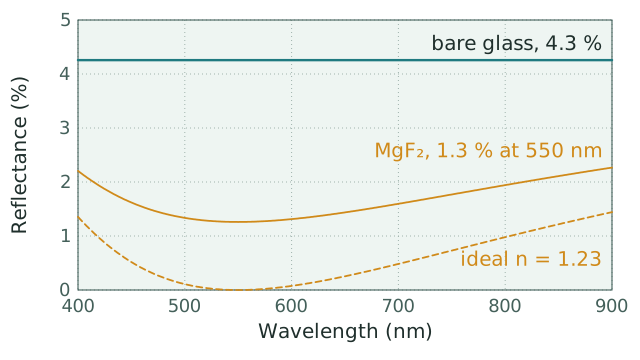
Computed normal-incidence reflectance of BK7 (, indices held constant): bare, with a quarter-wave MgF₂ layer (, 99.6 nm thick) designed for 550 nm, and with an ideal layer of . The MgF₂ layer brings 4.3 % down to 1.3 % at 550 nm and stays below 2.3 % from 400 to 900 nm.
| Substrate | Uncoated | Optimal | Practical material | Achieved |
|---|---|---|---|---|
| BK7 () | 4.3% | 1.23 | MgF₂ () | 1.3% |
| Fused silica () | 3.4% | 1.20 | MgF₂ | 1.8% |
| Silicon () | 30.9% | 1.87 | SiO + Si₃N₄ stack | |
| Germanium (, infrared) | 36% | 2.00 | ZnS () | 0.9% |
High-index substrates are the easier case, because films with indices near their ideal value exist; low-index glasses are the hard one. The quarter-wave thickness for some common cases, with the indices listed held constant:
| Film on substrate | Design | Thickness | Residual |
|---|---|---|---|
| MgF₂ (1.38) on BK7 (1.52) | 550 nm | 99.6 nm | 1.3% |
| MgF₂ (1.38) on BK7 (1.52) | 1064 nm | 192.8 nm | 1.3% |
| Si₃N₄ (1.99) on silicon (3.48) | 1550 nm | 194.7 nm | 0.4% |
| SiO₂ (1.45) on silicon (3.48) | 1550 nm | 267.2 nm | 6.1% |
Coating materials
A small set of dielectrics covers most coatings for the visible and near infrared. Approximate indices of thin films near 550 nm:
| Material | Index near 550 nm | Typical use |
|---|---|---|
| MgF₂ | 1.38 | Single-layer AR on glass; low-index outer layer of evaporated multilayers |
| SiO₂ | 1.45–1.47 | Low-index layer of most multilayer stacks, paired with one of the high-index oxides below |
| Al₂O₃ | 1.60–1.65 | Medium-index layer of three- and four-layer designs; also deposited by ALD |
| HfO₂ | 1.9–2.1 | High-index layer for UV and high-power laser coatings, paired with SiO₂ |
| ZrO₂ | about 2.0 | High-index layer for visible and near-infrared coatings, including high-power ones |
| Si₃N₄ | about 2.0; PECVD films vary with composition | Single-layer AR on silicon: photodiodes, solar cells, chip facets |
| SiON | between the SiO₂ and Si₃N₄ values, set by composition | Layers matched to a required index, as on waveguide facets |
| Ta₂O₅ | about 2.1 | Low-loss high-index layer, paired with SiO₂ in ion-beam-sputtered stacks |
| Nb₂O₅ | about 2.3 | High-index layer of sputtered coatings |
| TiO₂ | 2.2–2.5 | Highest-index common oxide for the visible; absorbs in the near UV |
Film indices depend on the deposition process. Evaporated films are slightly porous, take up water from the air and shift in index when they do; ion-assisted and sputtered films are denser, with indices closer to those of the bulk material. Production designs therefore use indices measured on films from the same process. Coatings for the 8–12 µm thermal band use a different set of materials, including ZnS and germanium, because SiO₂ absorbs strongly there.
V-coats and broadband coatings
Two-layer V-coat. A V-coat is a narrowband design, usually of two layers, that brings the reflectance to nearly zero at one wavelength; the name comes from the V-shaped reflectance curve around that wavelength. Listed from the air side:
| Material | Optical thickness |
|---|---|
| Low-index (e.g., MgF₂, ) | Quarter-wave |
| Higher-index, (1.70 on BK7) | Quarter-wave |
| Substrate | – |
With the two quarter-wave layers, reflectance is zero at the design wavelength when . At 550 nm on BK7 the pair is 99.6 nm of MgF₂ over 80.9 nm of the layer. With a fixed high-index material such as TiO₂ (), the two thicknesses are no longer quarter-wave and are solved numerically for zero reflectance. On BK7 at 550 nm one solution is 12.6 nm of TiO₂ on the glass under 128.9 nm of MgF₂, with nearly the same bandwidth as the quarter-wave pair; a second, 107.0 nm of TiO₂ under 70.4 nm of MgF₂, gives a V about half as wide. Commercial V-coats typically specify at the design wavelength.
Broadband coatings. For laser optics, narrow-band V-coats are acceptable. Imaging and white-light optics need a low reflectance across a band. The simplest broadband design is the three-layer quarter-half-quarter coating: from the air side, a quarter wave of low index, a half wave of high index and a quarter wave of medium index. At the design wavelength the half-wave layer has no effect and the two quarter waves act as a V-coat; away from it, the half-wave layer flattens the curve into a W with two minima. Production broadband coatings use 4–10 layers with numerically optimized thicknesses, producing across bands such as:
| Bandwidth | Typical applications |
|---|---|
| 400 – 700 nm (visible) | Camera lenses, eyepieces, prisms |
| 750 – 1100 nm (NIR) | Si detector front faces, NIR lenses |
| 1280 – 1320 nm + 1530 – 1565 nm (O- and C-band) | Telecom photodetectors |
| 8 – 12 μm (LWIR) | Thermal imaging optics |
Covering a wider band with the same number of layers leaves a higher residual reflectance.
The three designs compared. Computed at normal incidence on BK7 () with constant indices: the single MgF₂ layer and the quarter-wave V-coat above, both designed for 550 nm, and a quarter-half-quarter coating designed for 510 nm from MgF₂ (1.38), a high-index layer of 2.1 such as Ta₂O₅ and a medium-index layer of 1.63 such as Al₂O₃, which are 92.4, 121.4 and 78.2 nm thick.
| Design on BK7 | Layers, total thickness | Band with | Mean , 400–700 nm |
|---|---|---|---|
| Single MgF₂ layer, 550 nm | 1, 99.6 nm | none (minimum 1.26%) | 1.47% |
| Two-layer V-coat, 550 nm | 2, 180.5 nm | 498–614 nm | 1.12% |
| Quarter-half-quarter, 510 nm | 3, 292.0 nm | 410–675 nm | 0.19% |
The V-coat stays below from 513 to 593 nm and is the lowest of the three at 550 nm, but outside roughly 460–680 nm it reflects more than the single layer: 2.0% at 450 nm and 1.9% at 700 nm, against 1.6% at both.
The design method (the quarter-wave condition, the ideal-index rule, and worked examples on glass and silicon) is set out in the AR coating design article, and the AR coating thickness calculator evaluates it for any film, substrate and wavelength. For two-layer designs, oblique incidence, and s and p polarization separately, the Thin-Film Reflectance Calculator computes the full stack by the characteristic matrix method; the quarter-wave V-coat above is one of its presets.
Angle of incidence and polarization
AR coatings are designed for a specific angle of incidence. At an angle, the phase thickness of a layer is multiplied by , where is the angle of the light inside the film, so the quarter-wave condition, and with it the reflectance minimum of a single layer, moves to the shorter wavelength . A quarter-wave MgF₂ layer designed for 550 nm at normal incidence has its minimum at 472 nm when used at 45°. The average reflectance rises away from the design angle, and most of the rise is in the s-polarization. Uncoated glass shows the same split: at 45° it reflects 9.7% of s-polarized and 0.9% of p-polarized light, against 4.3% of both at normal incidence, and its p reflectance falls to zero at Brewster's angle, 56.7° for BK7. The V-coat above, used at 45°, reflects 1.9% (s) and 0.5% (p) at 550 nm, with its minima moved to about 480 nm. Coatings for tilted windows and for the second faces of 45° beamsplitters are therefore designed at their working angle.
Standard convention is to specify "average polarization" reflectance unless otherwise stated. Laser-line coatings used at an angle are designed and specified for the polarization of the laser, s or p; coatings for unpolarized or broadband light at an angle are specified by the average of the two. A complete AR specification states the wavelength or band, the maximum or average reflectance per surface across it, the angle of incidence, the polarization, the substrate and, for laser optics, the damage threshold.
AR and HR mirror coatings
AR coatings reduce reflection; HR (high-reflectance) coatings maximize it. Both are built from the same materials and the same quarter-wave layers, and they differ in how the partial reflections from the interfaces are phased. In an AR coating the reflections return out of phase and cancel. In an HR coating, alternating high- and low-index quarter-wave layers return every interface reflection in phase, so the reflections add: a quarter-wave stack, or distributed Bragg reflector. Ten pairs of TiO₂ and SiO₂ ( = 2.3 and 1.45) under a final TiO₂ layer reflect 99.99% at the design wavelength on glass, before absorption and scatter are counted. The high reflectance holds only within a band set by the index ratio, 480–644 nm for such a stack centered at 550 nm, and the edge of that band is what a dichroic mirror uses to separate wavelengths.
| Type | Layer structure | Typical |
|---|---|---|
| Single layer | 1 layer | 0.4 – 1.8% at the design wavelength |
| V-coat (single wavelength) | 2 layers | Near zero at the design wavelength, below 0.25% over about 80 nm |
| Broadband AR | 3 – 10 layers | Below about 0.5% across the band |
| HR dielectric (single wavelength) | 10 – 20 quarter-wave pairs | 99.9 – 99.99% |
| HR broadband (Bragg) | Chirped quarter-wave stack | 99 – 99.9% across band |
Partially reflecting optics, such as output couplers and plate beamsplitters, carry the reflecting coating on one face and an AR coating on the other, so that the second face adds little reflection of its own, which would otherwise appear as a ghost beam or as etalon fringes with the first face.
Deposition methods
| Deposition method | Typical materials | Thickness control |
|---|---|---|
| Thermal evaporation | MgF₂, ZnS, SiO | ~5 nm |
| E-beam evaporation | MgF₂, TiO₂, Ta₂O₅, Al₂O₃, ZrO₂, HfO₂ | ~2 nm |
| Ion-assisted deposition | Same materials, denser films | ~1 nm |
| Sputtering (magnetron) | TiO₂, SiO₂, Nb₂O₅ | ~1 nm |
| Atomic layer deposition (ALD) | TiO₂, Al₂O₃, HfO₂ | ~0.1 nm |
| Sol-gel | SiO₂ porous films | ~5 nm |
Layer thickness is controlled during deposition by a quartz crystal microbalance, which measures the deposited mass, and by optical monitoring of the transmittance or reflectance of the coated part or of a witness piece; together they give nanometer-level control of each layer.
Laser damage threshold
Coatings for high-power lasers need low absorption, since absorbed power heats the film and limits the power it survives. ZrO₂/SiO₂ stacks are used in the visible and near infrared and HfO₂/SiO₂ stacks for high-fluence pulsed UV, and ion-assisted deposition produces denser, lower-absorption films.
A laser-induced damage threshold is meaningful only with its units and test conditions. For pulsed lasers it is a fluence in J/cm², stated with the wavelength, pulse duration, repetition rate and beam diameter of the test; AR coatings of this kind have pulsed thresholds of 5–50 J/cm² for 10 ns pulses. Within the nanosecond range a pulsed threshold is commonly scaled to another pulse duration in proportion to , a rough rule that fails for picosecond and shorter pulses, where the damage mechanism changes. For continuous-wave lasers the threshold is quoted either as an irradiance in kW/cm² or as a linear power density in W/cm, the power divided by the beam diameter. The linear form follows from the physics of CW damage, which is mainly thermal: in the steady state, the peak temperature rise of a small absorbing spot on a thick substrate scales with the absorbed power divided by the spot radius, so a threshold in W/cm carries over between beam sizes better than one in W/cm². For scale, a 10 W beam with a 1 mm diameter has an irradiance of 1.3 kW/cm² when its power is divided by the area, 2.5 kW/cm² at the peak on axis, and a linear power density of 100 W/cm. Converting a threshold from one form to the other requires the beam diameter used in the test. The test methods are set by ISO 21254.
Coatings on semiconductors
Photonic chip facets. A polished silicon facet reflects 30.6% at 1550 nm (). At the facet of a waveguide the guided mode sets the reflection: in the plane-wave approximation, which is good for weakly guided modes and rough for tightly confined ones, the facet acts as a surface of index , the effective index of the mode, and the ideal single layer has . For light confined in the silicon the target approaches . A quarter wave of SiO₂ () is well below it and leaves 6.1% on bulk silicon, while silicon nitride () leaves 0.4%; silicon oxynitride, whose index is set between the oxide and nitride values by its composition, can match for any mode with between and 4.0. An inverse-taper edge coupler is the opposite case. At the facet its mode has spread into the oxide cladding, so lies a little above the oxide index of 1.444 and the bare facet reflects 3–4% (3.3% for , 4.0% for 1.5). A silica layer matches the cladding and leaves that unchanged, and the ideal index, about 1.2, is as far out of reach as it is on fused silica. Such facets are treated with a multilayer coating designed for the mode, an index-matched bond to the fiber, or an angled facet; each also weakens the Fabry-Pérot fringes that two reflecting facets produce in a chip's transmission spectrum, as described in Edge Coupler Alignment to Photonic Integrated Circuits. The coating is deposited after the facet is polished and is designed for the operating band, 1310 or 1550 nm.
Laser diode facets. On a laser diode facet, the anti-reflection coating raises the mirror loss and the front-facet slope efficiency and lowers the intensity inside the facet for a given output; the numbers are in Facet coatings and what they do to a laser diode. Gain chips for external-cavity lasers and semiconductor optical amplifiers need facet reflectances of or lower, down to for high-gain SOAs, and combine multilayer coatings with angled facets.
Solar cells. Solar cell front surfaces use AR coatings to maximize light absorption. The requirements differ from those of optics: a wide band (300 – 1100 nm for Si solar cells), a wide range of angles as the sun moves across the sky, and low cost. The standard solution is a single layer of Si₃N₄, 70 – 100 nm thick on silicon, which with puts the quarter-wave minimum between = 560 and 800 nm; the thickness is chosen to minimize the reflectance weighted by the solar photon flux. In production the nitride is deposited on a textured surface, and it also passivates the silicon.
Common questions
How thick is an anti-reflection coating?
A single-layer coating is a quarter wave thick in the film, : 99.6 nm of MgF₂ for 550 nm and 192.8 nm for 1064 nm. Multilayer coatings are built from layers of similar thickness; the three-layer broadband design above is 292 nm thick in total.
What materials are AR coatings made of?
MgF₂ () is the standard single layer on glass. Multilayer coatings pair SiO₂ () with a high-index oxide such as TiO₂, Nb₂O₅, Ta₂O₅, HfO₂ or ZrO₂, and silicon devices use silicon nitride, whose index of about 2.0 is close to the ideal 1.87 for silicon.
What is the difference between a V-coat and a broadband AR coating?
A V-coat is a two-layer coating that brings the reflectance close to zero at one wavelength; in the example above it stays below 0.25% over 80 nm and reaches 2.0% at 450 nm. A broadband coating uses three or more layers, typically 4–10, to hold the reflectance below about 0.5% across a band, 410–675 nm for the three-layer example, and suits imaging and white light, where a V-coat suits a single laser line.
How does an AR coating differ from a mirror (HR) coating?
Both are stacks of quarter-wave layers of the same materials. In an AR coating the reflections from the interfaces cancel; in a high-reflector, alternating high- and low-index layers return every reflection in phase, and 10–20 pairs reach 99.9–99.99%.
How is the laser damage threshold of an AR coating specified?
For pulsed lasers, as a fluence in J/cm² at a stated wavelength, pulse duration and beam size; for CW lasers, as an irradiance in kW/cm² or as a linear power density in W/cm, the power divided by the beam diameter. The two CW forms convert into each other only through the beam diameter used in the test.
References: H. A. Macleod, Thin-Film Optical Filters, 5th ed. (CRC Press, 2017), for single-layer, V-coat, quarter-half-quarter and quarter-wave mirror designs and for coating materials; M. Born and E. Wolf, Principles of Optics, 7th ed. (Cambridge University Press, 1999), §1.6, for the theory of stratified media; B. E. A. Saleh and M. C. Teich, Fundamentals of Photonics, 3rd ed. (Wiley, 2019), Ch. 7, for multilayer optics; B. C. Stuart, M. D. Feit, A. M. Rubenchik, B. W. Shore and M. D. Perry, "Laser-induced damage in dielectrics with nanosecond to subpicosecond pulses," Physical Review Letters 74, 2248 (1995); ISO 21254-1:2011, Lasers and laser-related equipment: Test methods for laser-induced damage threshold.