Acousto-optic modulator (AOM)
A crystal or glass block in which a radio-frequency sound wave diffracts part of a laser beam into a first order, shifted in frequency by exactly the drive frequency and deflected by twice the Bragg angle. Changing the RF power switches or attenuates the diffracted beam in about the time the sound takes to cross the beam; changing the RF frequency steers it.
An acousto-optic modulator (AOM) diffracts part of a laser beam off a sound wave traveling through a crystal or glass, and so switches, attenuates, steers or frequency-shifts the diffracted beam under the control of a radio-frequency (RF) drive. The diffracted first-order beam is shifted in optical frequency by exactly the drive frequency , upward or downward depending on the direction of the light relative to the sound. For efficient diffraction the light must meet the acoustic wavefronts at the Bragg angle , where is the acoustic velocity; with the vacuum wavelength, this is the angle measured in air. In tellurium dioxide (TeO) driven at 80 MHz in its longitudinal mode ( m/s), light at 1550 nm meets the sound at mrad (0.85°), and the first order leaves 1.7° from the undiffracted beam, 80 MHz higher or lower in frequency.
The RF power sets the fraction of the light that is diffracted, typically up to 70–95%. Switching the RF on or off switches the first order in about the time the sound takes to cross the beam: for a Gaussian beam of diameter the 10–90% rise time is , which is 0.15 µs for a 1 mm beam in TeO. AOMs are used for Q-switching and pulse picking, laser intensity stabilization, frequency shifting for heterodyne detection and laser cooling, beam deflection and scanning, and active mode locking.
How an AOM works
An AOM is a block of transparent material, usually TeO or fused silica, with a piezoelectric transducer bonded to one face and an acoustic absorber on the opposite face. The transducer converts the RF drive, from about 25 MHz in large-aperture Q-switches to about 2 GHz, into a sound wave that crosses the optical beam and is absorbed on the far side. Through the photoelastic effect, the strain in the wave modulates the refractive index and forms a moving phase grating whose period is the acoustic wavelength , and the light diffracts from this grating. A driver supplies the RF: an oscillator or synthesizer, an amplitude modulator for the control input, and a power amplifier.
When the interaction length is long enough that the Klein-Cook parameter is much greater than 1, with the vacuum wavelength and the refractive index, the sound column acts as a thick grating: light is diffracted efficiently into a single first order, and only when it arrives at the Bragg angle. This Bragg regime is the usual one for AOMs; for the light spreads into many orders at once (Raman-Nath diffraction). In the particle picture, each diffracted photon absorbs or emits one phonon: conservation of momentum, with , sets the angle, and conservation of energy sets the frequency shift. The same interaction with thermally excited sound waves is Brillouin scattering.
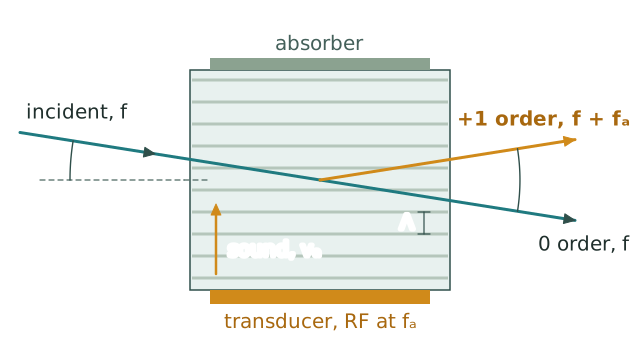
Bragg diffraction in an AOM, with angles exaggerated and refraction at the faces omitted; is the Bragg angle . In TeO driven at 80 MHz in its longitudinal mode ( m/s) at 1550 nm, µm and °, so the two orders separate by 1.7°. A beam that meets the oncoming sound wave, as drawn, is up-shifted into the +1 order.
Bragg angle and deflection
For Bragg diffraction, the geometry satisfies the Bragg condition:
where is the Bragg incidence angle, is the acoustic wavelength, is the acoustic velocity, and is the acoustic frequency. With the wavelength in the medium, , the formula gives the angle inside the crystal. At the entrance face, which is perpendicular to the acoustic wavefronts, refraction makes in air times its value inside, so with the vacuum wavelength the same formula gives the angle in air, the one set on the bench. The first order leaves at from the zero order.
Bragg angle in air for an 80 MHz drive; the two orders separate by twice these values:
| Wavelength | TeO, longitudinal ( m/s) | Fused silica ( m/s) |
|---|---|---|
| 532 nm | 5.07 mrad (0.29°) | 3.57 mrad (0.20°) |
| 633 nm | 6.03 mrad (0.35°) | 4.25 mrad (0.24°) |
| 780 nm | 7.43 mrad (0.43°) | 5.23 mrad (0.30°) |
| 1064 nm | 10.1 mrad (0.58°) | 7.14 mrad (0.41°) |
| 1550 nm | 14.8 mrad (0.85°) | 10.4 mrad (0.60°) |
Because the orders separate by small angles, under 2° at 80 MHz, the first order is usually picked off with an aperture or a mirror edge some distance downstream: the 20 mrad separation at 1064 nm in TeO grows to 6.1 mm at 30 cm.
Changing the drive frequency by turns the first order through in air, which is how an acousto-optic deflector scans a beam. The number of resolvable spots is , the sweep multiplied by the acoustic transit time across the optical aperture , to within a factor near one that depends on the beam profile and the resolution criterion. The slow shear mode of TeO ( m/s) gives many spots at the cost of access time: a 10 mm aperture resolves about 800 spots over a 50 MHz sweep, and each new frequency takes 16 µs to fill the aperture. Deflectors in that mode use anisotropic diffraction, in which the diffracted beam's polarization is orthogonal to the incident beam's and the Bragg condition takes a modified form.
Frequency shift
The diffracted beam is shifted in frequency by exactly the acoustic frequency, which is the RF frequency actually applied to the transducer:
The sign depends on whether the diffraction is up-shifting (anti-Stokes, +1 order) or down-shifting (Stokes, −1 order). Light whose direction has a component against the direction of the sound, meeting the oncoming wave as in the figure, is up-shifted; light traveling with the sound is down-shifted. Classically, the shift is the Doppler shift of light reflected at the Bragg angle from wavefronts moving at , which comes to exactly .
The shift is as accurate and stable as the RF source, and small in wavelength terms: 80 MHz at 1550 nm (193.4 THz) is 0.64 pm, or 4.1 parts in . It is detected as a beat note at when shifted and unshifted light are recombined on a photodiode, as in heterodyne detection and the delayed self-heterodyne linewidth measurement (how to measure laser linewidth).
Sending the first order back through the AOM, through a lens onto a mirror at its focus, shifts it a second time, by in total, and the second diffraction cancels the change of angle, so the returned beam retraces the input path whatever the drive frequency. Laser-cooling experiments use this double-pass arrangement to tune and switch beams near an atomic transition without realignment. In optical atomic clocks and other cavity-stabilized lasers, AOMs bridge the offset between a reference cavity's resonance and the frequency required, and serve as fast frequency actuators in Pound-Drever-Hall and frequency-comb locks.
Diffraction efficiency and RF power
The diffraction efficiency, the fraction of the incident power sent into the first order, is controlled by the RF drive power to the transducer:
where is the interaction length, is the transducer height, is the acousto-optic figure of merit, and is the acoustic power. Here is the vacuum wavelength and , with the effective photoelastic coefficient and the density. The typical maximum efficiency is 70–95%, depending on material and design. At low drive is proportional to , and the formula reaches 100% at
For TeO in its longitudinal mode, at 633 nm, so full diffraction at that wavelength takes of acoustic power: 0.58 W when the interaction length is ten times the transducer height. Fused silica, with (both values from Uchida and Niizeki), needs 23 times more for the same geometry, 13 W, and is chosen where its ultraviolet transmission, low absorption and high damage threshold matter more than drive power, as in high-power Q-switches. Crystalline quartz serves similar purposes, and germanium is used for CO lasers at 10.6 µm. The electrical RF power exceeds these acoustic figures by the loss in the transducer and its matching network. Since grows as , the same device needs 2.8 times as much power at 1064 nm and 6.0 times as much at 1550 nm as at 633 nm, before the wavelength dependence of is counted.
The response is linear in RF power only at low efficiency, so analog intensity control either works in that range or closes a feedback loop around the AOM. With the RF off, the first order carries only scattered light, which makes it the output for switching with high on/off contrast. The zero order keeps the remaining 5–30% of the light even at maximum efficiency, and it is the beam used where the AOM acts as a variable loss, as inside a Q-switched laser.
Rise time and beam size
When the RF is switched on, the sound front has to cross the optical beam before the whole beam diffracts, so the acoustic transit time sets the modulation rise and fall time:
where is the beam diameter at the AOM. For a 1 mm beam in TeO driven in its longitudinal mode, as in most modulators ( m/s), the transit time is 0.24 µs; in the slow shear mode used for deflectors and tunable filters ( m/s) it is about 1.6 µs.
For a Gaussian beam and a sharp sound front, the first-order power at each moment is proportional to the part of the beam's power that the front has already crossed. That fraction is an error function of time, and its 10–90% rise time is
with the intensity diameter of the beam at the AOM: 0.15 µs for the 1 mm beam in longitudinal TeO, and 1.0 µs in the slow shear mode.
| beam diameter | TeO, longitudinal | Fused silica |
|---|---|---|
| 0.1 mm | 15 ns | 11 ns |
| 0.2 mm | 30 ns | 21 ns |
| 0.5 mm | 76 ns | 54 ns |
| 1 mm | 152 ns | 107 ns |
| 2 mm | 305 ns | 215 ns |
The RF driver adds its own rise time, and the optical response lags the RF edge by the acoustic travel time from the transducer to the beam, 0.24 µs for each millimeter in longitudinal TeO. The Gaussian Beam Calculator gives the waist that a given lens produces.
Focusing more tightly shortens the rise time and widens the beam's angular spread. A Gaussian beam of diameter spreads over a full angle of in air, while the orders are apart, so the separation is times the spread: 15 for a 1 mm beam in the 80 MHz TeO example, and 1.5 at 0.1 mm, where the two orders are barely separated. A tightly focused beam also contains directions that miss the Bragg angle, which lowers the peak efficiency. The shortest useful rise time is therefore of the order of the RF period, 12.5 ns at 80 MHz, and faster switching calls for a higher drive frequency.
Uses
| Use | How the AOM is used |
|---|---|
| Laser intensity modulation | The RF amplitude sets the first-order power, following the sine-squared curve above |
| Intensity stabilization (noise eater) | A photodiode samples the output and a servo adjusts the RF power to hold it constant, suppressing intensity noise within a loop bandwidth limited by the acoustic delay |
| Q-switching | Inside the cavity, the RF drive diffracts light out of the resonator and holds the laser below threshold while the gain builds; removing the drive restores the low-loss cavity and releases a pulse (see Q-switching) |
| Pulse picking and gating | Gating the RF passes selected pulses of a mode-locked train into the first order, which needs a switching time shorter than the pulse spacing, 12.5 ns for an 80 MHz train; fiber-coupled AOMs also carve the probe pulses for coherent OTDR and distributed acoustic sensing |
| Frequency shifting | Offsets a beam by , or in double pass, for heterodyne detection, linewidth measurement, laser cooling, and offset locking to cavities, atomic references and comb lines |
| Beam deflection and scanning | Sweeping the drive frequency over turns the first order through , for laser scanning microscopy, optical tweezers and laser processing |
| Active mode locking | A mode locker has no absorber, so the sound reflects from the far face and forms a standing wave, which modulates the cavity loss at twice the drive frequency; the drive is set to half the cavity's free spectral range (see mode locking) |
| Cavity dumping | A short RF burst diffracts the circulating pulse out of the laser cavity through the first order |
Typical specifications
| Parameter | Telecom / visible (typical) | High-power |
|---|---|---|
| Operating wavelength | 400 nm – 2 µm | 1 µm |
| Acoustic frequency | 80 – 250 MHz | 25 – 80 MHz |
| Maximum diffraction efficiency | 80 – 90% | 75 – 85% |
| Rise/fall time | 10 – 100 ns | 100 ns – 1 µs |
| Aperture | 0.5 – 5 mm | 5 – 20 mm |
Optical power handling depends on the material's absorption and damage threshold, on the aperture and on the wavelength, so no single figure applies; datasheets give it for each device, usually as a maximum optical power density.
Comparison with electro-optic modulators
Electro-optic modulators, from bulk Pockels cells to waveguide Mach-Zehnder modulators based on the Pockels effect, switch in nanoseconds down to tens of picoseconds, limited by their drive electronics and electrode design; an AOM typically takes 10 ns to 1 µs. The AOM's first order is shifted in frequency, dark when the RF is off and separated from the input by angle, so no polarizers are needed, and the AOM needs an RF driver but no high-voltage supply of the kind a bulk Pockels cell uses. An electro-optic phase modulator adds sidebands and leaves the carrier frequency unchanged, and waveguide modulators reach the tens-of-gigahertz bandwidths of telecom transmitters.
Common questions
What does an AOM do in a laser system?
It diffracts part of the beam into a first order that is deflected by twice the Bragg angle and shifted in frequency by the RF drive frequency, with the RF power setting how much light is diffracted. It serves as a fast switch, variable attenuator, frequency shifter or beam deflector, for Q-switching, pulse picking, intensity stabilization, heterodyne detection and laser cooling.
How much does an AOM shift the laser frequency?
By exactly the RF drive frequency: an AOM driven at 80 MHz shifts the first order by 80 MHz, up in the +1 order and down in the −1 order, and a double pass shifts it by 160 MHz. At 1550 nm, 80 MHz corresponds to 0.64 pm in wavelength.
How is the Bragg angle of an AOM calculated?
In air, , with the vacuum wavelength, the drive frequency and the acoustic velocity. For TeO at 80 MHz and 1064 nm it is 10.1 mrad (0.58°), and the first and zero orders leave 20 mrad apart.
How fast can an AOM switch?
The 10–90% rise time is about for a Gaussian beam of diameter : 152 ns for a 1 mm beam and 15 ns for 0.1 mm in TeO. Tighter focusing makes the orders overlap, so the practical limit is of the order of one RF period; Pockels cells and waveguide electro-optic modulators switch faster.
What is the difference between an AOM and an EOM?
An AOM diffracts light off a sound wave and shifts its frequency; an electro-optic modulator changes the phase or polarization of the light through the Pockels effect. EOMs are faster, nanoseconds to picoseconds, while AOMs give a frequency-shifted output separated by angle, with high on/off contrast and no high-voltage drive.
References: B. E. A. Saleh and M. C. Teich, Fundamentals of Photonics, 3rd ed. (Wiley, 2019), chapter on acousto-optics. A. Yariv and P. Yeh, Photonics: Optical Electronics in Modern Communications, 6th ed. (Oxford University Press, 2007), chapter on the interaction of light and sound. A. Korpel, Acousto-Optics, 2nd ed. (Marcel Dekker, 1997). N. Uchida and N. Niizeki, "Acoustooptic deflection materials and techniques," Proceedings of the IEEE 61, 1073 (1973). W. R. Klein and B. D. Cook, "Unified approach to ultrasonic light diffraction," IEEE Transactions on Sonics and Ultrasonics SU-14, 123 (1967). E. A. Donley, T. P. Heavner, F. Levi, M. O. Tataw, and S. R. Jefferts, "Double-pass acousto-optic modulator system," Review of Scientific Instruments 76, 063112 (2005). W. Koechner, Solid-State Laser Engineering, 6th ed. (Springer, 2006).