Aberrations
Departures from ideal image formation in real optical systems. The principal categories (spherical, coma, astigmatism, field curvature, distortion, and chromatic) are the main targets of lens design and correction.
Aberrations are systematic departures from perfect image formation in real optical systems. A perfect (aberration-free) lens would image every object point to a single image point with the same magnification regardless of position and color. Real lenses blur, distort or shift the image in ways that depend on the aperture, the field angle and the wavelength, and reducing these errors to the level the application tolerates is the main task of lens design.
The principal aberrations. Seidel's third-order theory describes five monochromatic aberrations, and the dispersion of the glass adds two chromatic aberrations:
| Aberration | Description | Source |
|---|---|---|
| Spherical aberration | Rays at different aperture heights focus at different axial positions | Spherical lens surface; only paraxial rays focus exactly at the Gaussian focus |
| Coma | Off-axis points image as comet-shaped streaks | Magnification varies with the zone of the aperture for off-axis points |
| Astigmatism | Tangential and sagittal focal planes differ | Off-axis lens curvature is different in two perpendicular planes |
| Field curvature | Image is sharp on a curved surface, not a flat plane (Petzval surface) | Petzval sum of the element powers divided by their indices |
| Distortion | Magnification varies with position in image (barrel or pincushion) | Position of the aperture stop relative to the lens |
| Chromatic aberration (axial) | Different wavelengths focus at different axial positions | Refractive index varies with wavelength |
| Chromatic aberration (lateral) | Magnification varies with wavelength, so off-axis images in different colors are displaced sideways | Same |
Wavefront vs ray description. Aberrations can be characterized in two equivalent ways:
- Ray aberrations: deviations of actual ray positions from the ideal image point, measured in the image plane
- Wavefront aberrations: deviations of the actual wavefront from a sphere converging to the ideal image point, measured in the exit pupil
The wavefront description is more compact (single 2D function vs many rays) and is the standard in interferometric metrology.
Magnitude of aberrations. The size of an aberration depends as much on how a lens is used as on the lens. Spherical aberration grows as the fourth power of the beam diameter, so the same singlet can be diffraction-limited with a small beam and far from it with a large one. Computed by exact ray tracing at 587.6 nm for a plano-convex N-BK7 lens of 50 mm focal length and 5.3 mm center thickness, focusing a collimated beam, with the focus set for the smallest error:
| Beam diameter | Curved side toward the beam | Flat side toward the beam |
|---|---|---|
| 5 mm (f/10) | 0.011 wave RMS | 0.043 wave RMS |
| 10 mm (f/5) | 0.18 wave RMS | 0.70 wave RMS |
| 20 mm (f/2.5) | 3.0 wave RMS | 12 wave RMS |
A system is called diffraction-limited when its RMS wavefront error is below , 0.071 wave (the Maréchal criterion), which corresponds roughly to peak to valley for low-order aberrations (the Rayleigh quarter-wave rule). The lens above meets it at f/10 in either orientation and misses it at f/5; correcting the spherical aberration with a second element or an aspheric surface is what lets a doublet or an asphere reach the criterion at apertures where a singlet cannot.
Strehl ratio and the Maréchal criterion. A useful figure of merit:
where is RMS wavefront error. The Maréchal criterion states that systems with (Strehl ) are diffraction-limited: the aberrations are not the dominant blur. Aberrations reduce the coupling of a focused beam into a single-mode fiber in much the same way, since both the Strehl ratio and the coupling efficiency measure the overlap of the aberrated field with an ideal one (Wagner and Tomlinson).
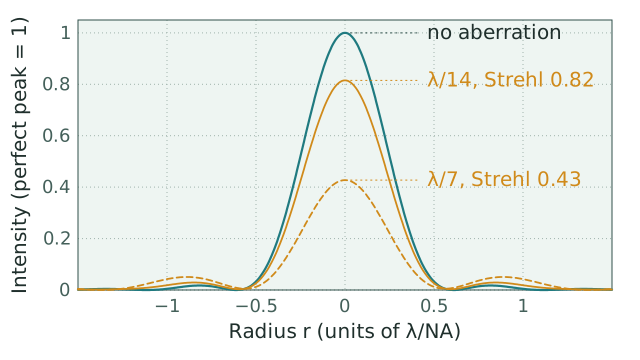
Computed point spread functions of a circular pupil with balanced primary spherical aberration (Zernike ) of 0, and RMS, normalized to the aberration-free peak, so that each peak height is the Strehl ratio. At it is 0.82, against 0.80 from the approximation above; at it is 0.43, where the approximation gives 0.19 and no longer applies. The light lost from the core goes into the rings.
Correcting aberrations.
| Aberration | Correction techniques |
|---|---|
| Spherical | Combination of positive/negative elements; aspheric surfaces |
| Coma | Symmetric placement of elements (Fraunhofer doublet); aplanatic designs |
| Astigmatism | Anastigmat designs (Cooke triplet etc.); cylindrical correction |
| Field curvature | Flattening field elements; Petzval condition designs |
| Distortion | Symmetric element arrangement; computational correction |
| Chromatic (axial) | Achromatic doublet (combine crown + flint glass with different dispersions) |
| Chromatic (lateral) | Designs symmetric about the stop; achromatized elements |
Aspheric lenses. Spherical surfaces are easy to manufacture but inherently introduce spherical aberration. Aspheric surfaces (parabolic, hyperbolic, polynomial-defined) can be designed to eliminate spherical aberration for one pair of conjugates. Molded aspheres are used in phone cameras, laser-diode collimators and fiber-coupling lenses, where a single element has to work at a small f-number.
Achromatic and apochromatic correction. A simple achromatic doublet corrects axial chromatic aberration at two wavelengths (typically F and C lines, 486 nm and 656 nm). The focus still varies at other wavelengths, a residual called the secondary spectrum:
| Lens design | Wavelengths corrected | Residual chromatic |
|---|---|---|
| Achromatic doublet | 2 | Secondary spectrum of about with ordinary crown and flint glasses (0.5 μm per mm of focal length) |
| Apochromatic | 3 | Tertiary spectrum, well below an achromat's secondary spectrum |
| Superachromatic | 4 | Smaller still, over a wider band |
Apochromatic designs use specialty glass (ED, fluorite, ultra-low-dispersion) at higher cost.
Aberrations in microscopy. Microscope objectives are classed by how far their aberrations are corrected (Murphy and Davidson):
| Class | Chromatic correction | Spherical correction |
|---|---|---|
| Achromat | Two wavelengths, red and blue | One wavelength, green |
| Fluorite (semi-apochromat) | Two or three wavelengths | Two or three wavelengths |
| Apochromat | Three or more wavelengths | Three or more wavelengths |
The prefix "plan" marks an objective whose field curvature is also corrected, so that the whole field is in focus at once on a camera. Objectives are also corrected for a specified cover-glass thickness, usually 0.17 mm, and in high-NA dry and water-immersion objectives a cover glass of the wrong thickness adds spherical aberration, which is why some of them carry a correction collar.
Adaptive optics correction. Where the aberration changes with time, as with atmospheric turbulence, biological samples or thermal lensing, a wavefront sensor measures it and a deformable mirror corrects it in real time. Applications include:
- Ground-based astronomy (correcting atmospheric blur)
- Retinal imaging (correcting the eye's own aberrations to resolve individual photoreceptors)
- Deep-tissue microscopy (correcting sample-induced aberrations)
- High-power laser systems (correcting thermal-lensing in gain media)
Common questions
What is an aberration in optics?
An aberration is any systematic departure of a real optical system from ideal image formation: the lens fails to bring all the rays from a point to one point, at the right place, for every color. It is a property of the design and the glass rather than a manufacturing defect, which is why it can be computed and corrected, and it is distinct from diffraction, which limits even a perfect lens to an Airy disk.
What are the main types of aberration, with examples?
Five monochromatic (Seidel) aberrations and two chromatic ones. Spherical aberration: a plano-convex singlet focusing a laser beam to a halo instead of a point. Coma: comet-shaped stars at the edge of a fast telescope's field. Astigmatism: an off-axis point imaged as two perpendicular lines at different focus settings. Field curvature: a flat target sharp in the center and soft in the corners. Distortion: barrel in wide-angle lenses, pincushion in telephoto lenses. Axial and lateral chromatic aberration: colored fringes on high-contrast edges. Each has a standard correction, listed in the table above.
Are visual aberrations the same thing?
Yes. The eye is an optical system, and its aberrations are described by the same theory and measured with the same wavefront instruments. Defocus (myopia and hyperopia) and astigmatism are the low-order terms that spectacles correct; spherical aberration, coma, and trefoil are the higher-order terms that wavefront-guided refractive surgery and custom lenses target, typically a few tenths of a micrometer RMS at a large pupil, and they limit visual acuity even with a perfect spectacle prescription.
How much aberration is acceptable?
The Maréchal criterion: if the RMS wavefront error is below , the Strehl ratio is above 0.8 and the system is diffraction-limited, meaning the aberrations blur the image less than diffraction does. At 633 nm that is 45 nm RMS. By exact ray tracing at 587.6 nm, a plano-convex lens of 50 mm focal length with its curved side toward a collimated beam meets it with a 5 mm beam (0.011 wave RMS) and misses it with a 10 mm beam (0.18 wave RMS).
References: Saleh & Teich, Fundamentals of Photonics (3rd ed., 2019), Ch. 1 (geometric optics aberrations); Born & Wolf, Principles of Optics (7th ed., 1999), Ch. 5 for the canonical Seidel-theory derivation; Welford, Aberrations of Optical Systems (Adam Hilger, 1986) for the comprehensive engineering treatment. D. B. Murphy and M. W. Davidson, Fundamentals of Light Microscopy and Electronic Imaging, 2nd ed. (Wiley-Blackwell, 2013). W. G. Wagner and W. J. Tomlinson, "Coupling efficiency of optics in single-mode fiber components," Applied Optics 21, 2671 (1982).