Non-radiative recombination (Shockley-Read-Hall, Auger and surface)
Recombination of electrons and holes that releases the energy as heat or hands it to a third carrier instead of emitting a photon: Shockley-Read-Hall recombination through defect levels, Auger recombination at high carrier density, and surface recombination at interfaces. Together they set the internal quantum efficiency and carrier lifetime of every LED and laser, and the ABC model, An + Bn² + Cn³, is how the three are counted against radiative emission.
Non-radiative recombination is the recombination of an electron and a hole without the emission of a photon. The energy goes into lattice vibrations, as heat, or to a third carrier. Three mechanisms account for it: Shockley-Read-Hall (SRH) recombination through defect levels in the bandgap, Auger recombination at high carrier density, and surface recombination at interfaces. Each competes with radiative recombination for the same carriers, and the share they take sets the internal quantum efficiency of LEDs and lasers and the carrier lifetime.
The ABC model
For an excess carrier density under high injection, the total recombination rate per unit volume is counted as
where is the SRH rate, the radiative coefficient and the Auger coefficient; surface recombination adds to in small devices. The internal quantum efficiency is the radiative share, . It peaks at , where SRH and Auger take equal shares. With the illustrative coefficients used in the radiative recombination entry ( s⁻¹, cm³/s, cm⁶/s), the peak is at cm⁻³, where radiation takes 83% and SRH and Auger 8% each. At lower density SRH takes over, and at higher density Auger, the origin of efficiency droop in LEDs.
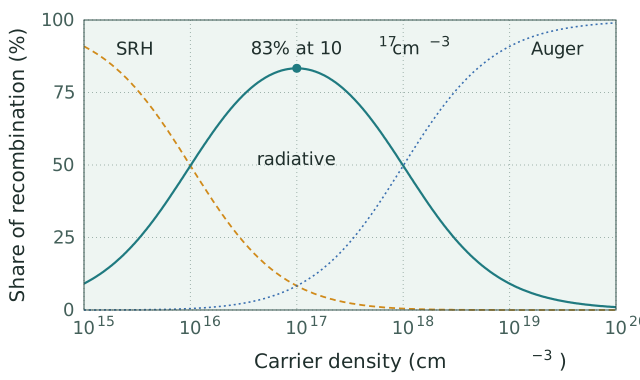
Computed from the ABC model with the coefficients above ( s⁻¹, cm³/s, cm⁶/s). SRH dominates at low density and Auger at high density; the radiative share peaks at cm⁻³.
Shockley-Read-Hall recombination
An electron and a hole recombine in two steps through a defect level in the bandgap: the defect captures one carrier and then the other, and each capture gives up its energy to phonons. The rate is
where and depend on the energy of the trap and and are the capture lifetimes for electrons and holes. Under high injection () it reduces to , with . Levels near midgap are the most effective, since a carrier caught there is unlikely to be re-emitted before the other carrier arrives.
The defects that provide SRH centers include:
- Point defects: vacancies, interstitials and antisites.
- Dislocations, above all the threading dislocations that run up through a layer grown on a mismatched substrate.
- Impurity atoms, such as iron in silicon or InP.
- Stacking faults and grain boundaries.
The SRH lifetime is the most variable of the three mechanisms, since it depends on the density of defects, which purification, lattice matching and careful growth reduce by orders of magnitude.
Auger recombination
In Auger recombination the energy of the recombining pair goes to a third carrier, an electron or a hole, which is lifted high into its band and then loses the energy to phonons. Needing three carriers, the rate grows as the cube of the density:
Auger recombination grows stronger as the bandgap narrows. The coefficient is about cm⁶/s in GaAs and to cm⁶/s in InGaAsP emitting at 1.55 µm; the Auger entry tabulates values by material. It also rises steeply with temperature, and it is a leading reason that the threshold of InP-based telecom lasers is more temperature-sensitive than that of GaAs lasers: their characteristic temperature is typically 50 to 70 K against 120 to 160 K, with carrier leakage over the barriers adding to the difference.
Surface recombination
A surface or interface interrupts the crystal and leaves broken bonds and other states in the gap, a dense sheet of SRH centers. Its strength is given by the surface recombination velocity : the flow of carriers into the surface, with the diffusion coefficient, equals times the excess carrier density at the surface. varies over about five orders of magnitude, from roughly cm/s on a bare GaAs surface to roughly 10 cm/s on silicon under a thermally grown oxide; InP surfaces recombine much more slowly than GaAs.
Surface recombination matters when a device is not much wider than the distance carriers diffuse before recombining. Etched mesas, micropillars and micro-LEDs a few micrometers across lose a growing share of their carriers at the sidewalls, and red AlGaInP micro-LEDs suffer more than blue InGaN ones because carriers diffuse further in AlGaInP and its surfaces recombine faster. In edge-emitting lasers the active layer is either left unetched under a ridge or etched and buried by regrowth of a wider-gap material, the buried heterostructure, so that its sides are interfaces between matched crystals rather than open surfaces.
Temperature dependence
- SRH: capture by multiphonon emission is thermally activated, so for most traps the rate rises with temperature (Henry and Lang).
- Auger: in the simplest models the coefficient rises as , where is the threshold energy the process needs.
- Radiative: falls as the temperature rises, since the carriers spread over more states.
The result is that the internal quantum efficiency of an emitter falls with temperature, and more steeply in narrow-gap materials.
Reducing non-radiative recombination
| Measure | What it reduces |
|---|---|
| High-purity growth | SRH, through fewer impurities and point defects |
| Lattice matching, or graded buffers and defect filters | SRH at threading dislocations |
| Surface passivation | Surface recombination |
| Buried heterostructure regrowth | Recombination at the etched sides of the active stripe |
| Strained quantum wells | Auger, by lowering the carrier density needed for gain |
| Cooling | All thermally activated processes |
Strained quantum wells were proposed in 1986 by Adams and by Yablonovitch and Kane: the strain lowers the hole effective mass, so the laser reaches threshold at a lower carrier density, where the Auger rate is much smaller.
Related losses
In photodetectors the same defect levels that act as SRH centers in emitters generate carriers thermally and produce dark current, so a low dark current and a high radiative efficiency both call for defect-free, well-passivated material.
In a laser, Auger recombination and free-carrier absorption both grow with carrier density, the first as and removing carriers, the second as and adding optical loss. Both rise with temperature and contribute to the thermal rollover of the L–I curve.
Why silicon emits poorly
Silicon's radiative coefficient is cm³/s at 300 K (Trupke et al.), about twenty thousand times smaller than the cm³/s of GaAs, because its indirect gap needs a phonon for every photon. At cm⁻³ the radiative lifetime is 2.1 ms, long enough for SRH and Auger recombination to take almost every carrier first. The best silicon LEDs, built with the surface passivation and light trapping of high-efficiency solar cells, reached about 1% power efficiency at room temperature (Green et al.), and lasers on silicon use III-V gain material.
Common questions
What is non-radiative recombination?
The recombination of an electron and a hole that releases its energy as heat, or to a third carrier, instead of as a photon. It competes with light emission for the same carriers and lowers the efficiency of LEDs and lasers.
What are the types of non-radiative recombination?
Shockley-Read-Hall recombination through defect levels, which dominates at low carrier density; Auger recombination, which hands the energy to a third carrier and dominates at high density; and surface recombination at interfaces and etched sidewalls.
What is the difference between radiative and non-radiative recombination?
Radiative recombination emits a photon carrying the pair's energy, at a rate . Non-radiative recombination gives the energy to phonons or another carrier, at rates (SRH) and (Auger), and produces heat instead of light.
How does non-radiative recombination affect efficiency?
The internal quantum efficiency is , so SRH limits it at low density and Auger at high density, which is the droop of LEDs at high current. In lasers, both raise the threshold current, and Auger makes it more sensitive to temperature.
References: Coldren, Corzine and Mašanović, Diode Lasers and Photonic Integrated Circuits (2nd ed., Wiley, 2012), ch. 2; Sze and Ng, Physics of Semiconductor Devices (3rd ed., Wiley, 2007), for SRH statistics; Piprek, Semiconductor Optoelectronic Devices (Academic Press, 2003); C. H. Henry and D. V. Lang, "Nonradiative capture and recombination by multiphonon emission in GaAs and GaP," Phys. Rev. B 15, 989 (1977); A. R. Adams, "Band-structure engineering for low-threshold high-efficiency semiconductor lasers," Electron. Lett. 22, 249 (1986); E. Yablonovitch and E. O. Kane, "Reduction of lasing threshold current density by the lowering of valence band effective mass," J. Lightwave Technol. 4, 504 (1986); T. Trupke et al., "Temperature dependence of the radiative recombination coefficient of intrinsic crystalline silicon," J. Appl. Phys. 94, 4930 (2003); M. A. Green et al., "Efficient silicon light-emitting diodes," Nature 412, 805 (2001).