Longitudinal mode spacing
The frequency separation between adjacent longitudinal modes of an optical cavity, equal to the free spectral range c/(2 n_g L). A 300 µm InGaAsP diode laser has modes 139 GHz (1.11 nm) apart; a 30 cm helium-neon laser, 500 MHz.
The longitudinal mode spacing of an optical cavity is the frequency gap between adjacent longitudinal modes, the discrete frequencies at which a round trip adds a whole number of wavelengths. For a linear cavity of length and group index it is , the inverse of the round-trip time and the same quantity as the cavity's free spectral range. A 300 µm InGaAsP diode laser has modes 139 GHz apart, 1.11 nm at 1550 nm; a 30 cm helium-neon laser has them 500 MHz apart.
Mode spacing formula
For a linear (standing-wave) cavity, light crosses the length twice per round trip:
where is the round-trip time. For a ring cavity of circumference , light passes once per round trip and the factor of 2 drops out:
The Fabry-Perot Cavity Calculator gives the spacing in frequency and wavelength for any cavity length and group index, together with the mode number and the width of each mode.
Why the group index sets the spacing
The spacing is the inverse of the round-trip group delay, so it uses the group index rather than the phase index :
In a dispersive medium the two differ considerably. For an InGaAsP laser waveguide at 1550 nm, while , so using in the formula overstates the spacing by 12.5%. In air the two differ by about one part in a million, and either serves.
Mode spacing in wavelength
Near a wavelength , the spacing in wavelength is
For a 500 µm InGaAsP laser at 1550 nm, = 0.67 nm.
| Cavity | at 1550 nm |
|---|---|
| 300 µm InGaAsP | 1.11 nm |
| 500 µm InGaAsP | 0.67 nm |
| 1000 µm InGaAsP | 0.33 nm |
| 5 cm external cavity | 0.023 nm |
| 30 cm air cavity | 0.004 nm |
| 1 m air cavity | 0.0012 nm |
Typical mode spacings
| Cavity | Length | Medium | ||
|---|---|---|---|---|
| Fabry-Perot diode laser | 300 µm | InGaAsP | 3.6 | 139 GHz |
| Fabry-Perot diode laser | 500 µm | InGaAsP | 3.6 | 83 GHz |
| Fabry-Perot diode laser | 1000 µm | InGaAsP | 3.6 | 42 GHz |
| VCSEL | 1 µm | GaAs and DBR | 37 THz | |
| External-cavity diode laser | 5 cm | air and chip | effective | 2.9 GHz |
| Helium-neon (typical) | 30 cm | air | 1.00 | 500 MHz |
| Ti:sapphire | 1.8 m (folded) | air | 1.00 | 83 MHz |
| Bench-top Nd:YAG | 30 cm | mostly air | 1.0 | 500 MHz |
| Fiber ring laser | 10 m | silica | 1.47 | 20 MHz |
| Fiber ring laser | 100 m | silica | 1.47 | 2 MHz |
| Silicon microring | 100 µm circumference | silicon wire | 4.2 | 714 GHz |
| Microsphere resonator | 1 mm diameter | silica | 1.45 | 66 GHz |
Mode spacing and gain bandwidth
How many modes lase depends on how many fall under the gain curve:
| Regime | Behavior | Examples |
|---|---|---|
| Spacing much larger than the gain bandwidth | One longitudinal mode | VCSELs |
| Spacing comparable to the gain bandwidth | One to a few modes | Helium-neon lasers: 500 MHz spacing under a 1.5 GHz Doppler-broadened gain curve |
| Spacing much smaller than the gain bandwidth | Many modes, unless a filter selects one | Fabry-Perot diode lasers, solid-state and fiber lasers |
A semiconductor gain spectrum is several terahertz wide. A VCSEL's 1 µm cavity puts its modes more than 30 THz apart, so only one falls within the gain, while a 300 µm edge emitter has dozens of modes 139 GHz apart under it and runs multimode unless a grating selects one, as in a DFB laser.
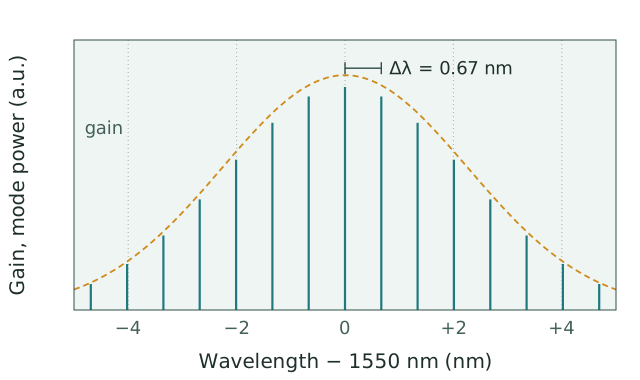
Modes of a 500 µm InGaAsP laser at 1550 nm (), spaced = 0.67 nm apart, under a schematic gain curve.
Mode number
The longitudinal mode number is the number of wavelengths in a round trip:
with the phase index. For a 300 µm InGaAsP laser at 1550 nm (), . What matters physically is the position of a mode relative to the gain peak, not its absolute number.
Measuring the mode spacing
A grating optical spectrum analyzer with 0.02 nm resolution separates the modes of cavities with up to about 6 cm of air path at 1550 nm. The modes of longer lasers need a scanning Fabry-Perot interferometer or an RF measurement: adjacent modes falling on a photodetector beat at , so an external-cavity laser a few centimeters long shows a beat note at a few gigahertz on an RF spectrum analyzer, a direct check on whether it runs in one mode. The 40 to 140 GHz beat of a diode laser chip is beyond the bandwidth of most detectors.
Side modes and mode hops
In a multimode laser, the modes near the gain peak compete for the same inversion. The side-mode suppression ratio (SMSR) compares the dominant mode with the strongest side mode; telecom DFB lasers are typically specified above 35 dB.
A mode hop is a jump from one longitudinal mode to the next when the gain peak moves relative to the mode positions, usually with temperature or current. The jump is one mode spacing, about 1.1 nm for a 300 µm Fabry-Perot diode at 1550 nm; DFB lasers are designed not to hop within their rated current and temperature range.
Choosing the cavity length
The cavity length is the design parameter that sets the spacing:
- Communications lasers: chips 200 to 500 µm long, with spacings of 208 to 83 GHz.
- Single-frequency lasers: a cavity short enough that only one mode fits under the gain, or DFB and DBR gratings that select one mode.
- Mode-locked lasers: the spacing is the pulse repetition rate, so a 100 MHz rate needs a 1.5 m linear cavity in air.
- Frequency combs: the spacing is the comb's tooth spacing.
An external cavity lengthens a diode laser's effective cavity and brings its modes closer together. It also narrows the linewidth, which in the Schawlow-Townes picture falls as at a given output power, at the cost of denser modes and a narrower tuning range between hops.
Common questions
What is the formula for longitudinal mode spacing?
for a linear cavity of length and group index , and for a ring of circumference . In wavelength, .
What is the mode spacing of a diode laser?
For InGaAsP chips at 1550 nm with : 139 GHz (1.11 nm) for 300 µm, 83 GHz (0.67 nm) for 500 µm and 42 GHz (0.33 nm) for 1 mm.
Why does the mode spacing use the group index?
The spacing is the inverse of the time a round trip takes, and that time is set by the group velocity. In a semiconductor the group index exceeds the phase index by about 12%, so the phase index would give the wrong spacing.
Is longitudinal mode spacing the same as free spectral range?
Yes, for a given cavity they are the same number. "Mode spacing" is the usual term for lasers, and "free spectral range" for passive cavities, etalons and filters.
References: Saleh and Teich, Fundamentals of Photonics (3rd ed., Wiley, 2019), ch. 11 (laser resonators); Coldren, Corzine and Mašanović, Diode Lasers and Photonic Integrated Circuits (2nd ed., Wiley, 2012), ch. 3, for the group-index treatment; Siegman, Lasers (University Science Books, 1986), ch. 11.