Airy disk (Airy pattern)
The bright central spot of the diffraction pattern that an aberration-free lens with a round aperture makes of a point source: diameter 2.44 λN, or 1.22 λ/NA, holding 83.8% of the light, surrounded by faint rings. It sets the Rayleigh resolution limit of cameras, telescopes and microscopes.
The Airy disk (also spelled Airy disc) is the bright central spot that an aberration-free lens with a round aperture makes of a point source, and its diameter to the first dark ring is , where is the f-number, or in terms of the numerical aperture. The radius is therefore : 5.4 µm at 550 nm and f/8, and 240 nm in the specimen plane of a 100×/1.40 oil objective at the same wavelength, which is the Rayleigh resolution limit of that objective. The disk holds 83.8% of the light and faint rings carry the rest; the whole pattern is the Airy pattern, and in confocal microscopy the disk's diameter, projected to the pinhole, is the Airy unit (AU) in which pinhole sizes are quoted.
The Airy pattern is the diffraction pattern of a circular aperture; George Biddell Airy derived it in 1835 for the object glass of a telescope. It is the point spread function of every aberration-free imaging system with a round pupil, which is why its dimensions appear in every statement of resolution for telescopes, camera lenses, microscope objectives and focused laser beams. The Airy Disk Calculator evaluates everything in this entry for any wavelength and f-number, aperture and focal length, or numerical aperture.
The formula
For an aperture of diameter illuminated uniformly at wavelength , the intensity at an angle from the axis is
where is the Bessel function of the first kind of order one and is the on-axis intensity. In the focal plane of a lens of numerical aperture the same pattern appears as a function of the radial distance from the axis, with . The dark rings fall at the zeros of and the bright rings at the zeros of , which are tabulated; the numbers below are computed from them.
| Feature | Angular radius | Radius in the focal plane | Energy inside | |
|---|---|---|---|---|
| First dark ring (edge of the Airy disk) | 3.832 | 83.8 % | ||
| First bright ring, peak 1.75 % of center | 5.136 | 86.7 % | ||
| Second dark ring | 7.016 | 91.0 % | ||
| Second bright ring, peak 0.42 % | 8.417 | 92.2 % | ||
| Third dark ring | 10.173 | 93.8 % | ||
| Third bright ring, peak 0.16 % | 11.620 | 94.4 % | ||
| Fourth dark ring | 13.324 | 95.2 % |
The full width at half maximum of the central peak is in angle, or in the focal plane, a little more than 40 % of the disk diameter; when a star image is fitted with a Gaussian, this is the width that comes out, not the dark-ring diameter.
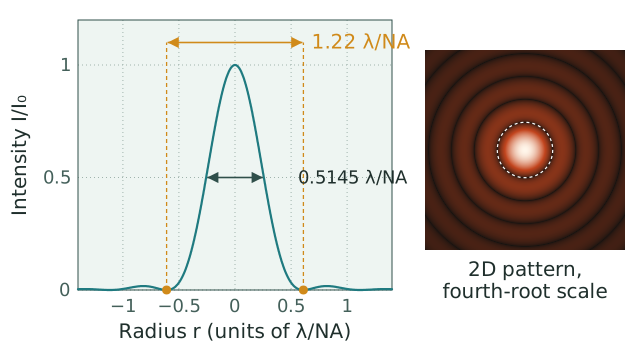
Computed with , against radius in units of : the first dark ring at bounds a disk of diameter , and the FWHM is . The 2D pattern at right is shown on a fourth-root intensity scale so that the rings are visible; the dashed circle is the first dark ring.
Airy disk diameter and radius
The diameter of the disk, measured between the first dark rings, is
with the focal length, the f-number, and for a lens in air that obeys the sine condition. The radius to the first dark ring, , is the Airy radius, and it is the number that the Rayleigh criterion uses. Both forms say the same thing: the spot scales with wavelength and shrinks as the cone of light converging on the focus widens. A slower lens, a longer focal length for the same aperture, or a longer wavelength all make a bigger disk, and no design choice makes it smaller than this for a given cone angle, because the limit comes from the wave nature of light rather than from the lens. This is the diffraction limit in its most concrete form.
| System | NA or | Airy disk diameter | FWHM | |
|---|---|---|---|---|
| Microscope objective 100×/1.40 oil | 550 nm | 1.40 | 479 nm | 202 nm |
| Microscope objective 40×/0.65 | 550 nm | 0.65 | 1.03 µm | 435 nm |
| Camera lens, f/4 | 550 nm | 0.125 | 5.4 µm | 2.3 µm |
| Camera lens, f/16 | 550 nm | 0.031 | 21.5 µm | 9.1 µm |
| Telescope, 8-inch f/10 | 550 nm | 0.05 | 13.4 µm | 5.7 µm |
| Photolithography stepper (dry ArF) | 193 nm | 0.95 | 248 nm | 105 nm |
| Optical disc drive (Blu-ray) | 405 nm | 0.85 | 581 nm | 245 nm |
| HeNe focused by a 100 mm f/2 lens | 633 nm | 0.25 | 3.1 µm | 1.3 µm |
| 1550 nm lens matched to single-mode fiber | 1550 nm | 0.14 | 13.5 µm | 5.7 µm |
The Airy formula describes uniform illumination of the pupil, which is what a star, a distant point object, or a heavily overfilled aperture provides. A Gaussian laser beam that underfills the lens focuses to a Gaussian spot with no rings at all, and its waist is set by the beam diameter on the lens rather than by the lens aperture; a beam truncated near its diameter gives something in between, with weaker rings than the Airy pattern and a slightly larger core. Apodization, the deliberate softening of the pupil edge, trades a wider central spot for suppressed rings in exactly this way.
Encircled energy: how much light is in the disk
The fraction of the total power inside a circle of radius has a closed form,
which gives 83.8 % inside the first dark ring, 91.0 % inside the second, 93.8 % inside the third and 95.2 % inside the fourth. Half of the power lies within of the center, just outside the half-maximum radius of . The first bright ring therefore carries 7.2 % of the light, the second 2.8 %, the third 1.5 %, and the tail converges slowly, as . The central disk is nevertheless the working spot size: it holds about five sixths of the energy in a region whose peak intensity is 57 times that of the brightest ring. On a linear display only the disk is visible; the rings appear when a star image is overexposed or a camera saturates, and on a logarithmic stretch the third ring is still plain at 0.16 percent of the peak.
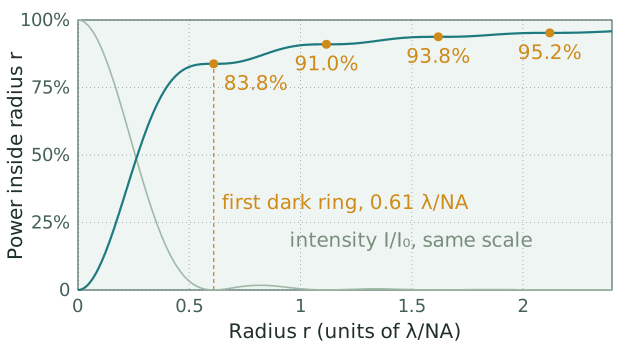
Computed encircled energy with . The curve flattens at each dark ring of the pattern, marked with the share of the power inside it; the gray curve is the intensity on the same scale.
Airy disk and the Rayleigh criterion
Two point sources of equal brightness imaged incoherently produce two Airy patterns whose intensities add. Rayleigh's criterion calls them resolved when the center of one falls on the first dark ring of the other, a separation equal to the Airy radius,
At that separation the summed intensity at the midpoint is 73.5 % of the two peaks, a dip of 26.5 %, which the eye or a detector sees comfortably. The Sparrow criterion asks for the separation at which the dip disappears altogether, where the second derivative of the summed profile vanishes at the midpoint; for a circular aperture that is , or 0.78 of the Rayleigh distance, and it is the practical limit for a detector that measures the profile rather than looks at it. Abbe's limit for a microscope, , comes from a different argument, the smallest grating period whose first diffraction order the objective still collects, and lands between the two at 0.82 of the Rayleigh distance. In angle, the Rayleigh limit of a telescope at 550 nm is : 0.68 arcseconds for a 203 mm aperture and 0.058 arcseconds for a 2.4 m mirror. Dawes' empirical limit for splitting equal double stars by eye, , is 16 % tighter than Rayleigh and 8 % looser than Sparrow, which is roughly what a trained observer manages.
Airy disk in microscopy
For an objective the radius is the resolution in the specimen plane, with NA including the immersion index, so a 100×/1.40 oil objective at 550 nm resolves 240 nm and a 40×/0.65 dry objective 516 nm. Sampling that pattern on a camera brings in the magnification: the pixel pitch divided by the magnification is the pixel size at the specimen, and the Nyquist condition asks for a pixel no larger than at the specimen, which is 2.44 of them per Airy radius. A 6.5 µm pixel behind the 100×/1.40 objective is 65 nm at the specimen, 3.7 pixels per Airy radius, comfortably sampled; the same camera behind a 20×/0.75 objective gives 325 nm pixels against a 447 nm Airy radius, 1.4 per radius, undersampled, and a 1.5× or 2× intermediate magnification fixes it.
The Airy unit (AU)
Confocal microscopes specify the pinhole in Airy units, where 1 AU is the Airy disk diameter projected to the pinhole plane. For a 63×/1.40 oil objective at 520 nm, 1 AU is 453 nm in the specimen and 28.5 µm in a pinhole plane at 63× magnification. A pinhole of 1 AU passes the disk and rejects most of the rings, and the axial sectioning improves as it closes below that, at the cost of signal.
High numerical aperture
Above about NA 0.7 the scalar pattern is only approximate: Richards and Wolf's vector treatment shows that the focal spot of linearly polarized light is no longer circular but elongated along the polarization direction, with the departure growing with the cone angle, and confocal and STED point spread functions are calculated with the vector theory.
Airy disk in cameras: f-number and pixel size
The Airy disk diameter in pixels is for a pixel pitch . At 550 nm and f/4 the disk is 5.4 µm, 1.4 pixels of a 3.76 µm sensor; at f/16 it is 21.5 µm, 5.7 pixels, and fine detail is visibly blurred even though depth of field is at its best. The f-number at which the disk spans two pixels, , is f/3.6 for 2.4 µm pixels, f/5.6 for 3.76 µm and f/12.5 for 8.4 µm, and it marks where stopping down further costs resolution that the sensor could otherwise record. The crossover is soft because the disk's energy is concentrated in a FWHM only 42 % of its diameter, which is why images remain acceptably sharp a stop or two past it.
Beyond the Airy disk
Several microscopy techniques resolve detail finer than the Airy radius without contradicting the physics behind it. Structured illumination doubles the resolution by mixing in an illumination pattern that shifts high spatial frequencies into the passband of the objective. Stimulated emission depletion (STED) uses a second, ring-shaped beam to switch off fluorescence everywhere except the center of the excitation spot, leaving an effective spot of a few tens of nanometers. Single-molecule localization methods (PALM and STORM) fit the Airy pattern of one emitter at a time and locate its center to about a tenth of the pattern's width, a precision, not a resolution, that reaches 10 to 20 nm when enough photons are collected. Near-field scanning optical microscopy avoids the far-field pattern altogether with a sub-wavelength probe held within nanometers of the surface. In every case the Airy pattern is still the image of each emitter; the techniques add information that the pattern alone does not carry.
Common questions
What is the formula for the Airy disk diameter?
The diameter of the central bright disk, measured between the first dark rings, is , where is the f-number, or equivalently . The radius to the first dark ring is half that, . For green light at 550 nm through an f/4 lens the disk is 5.4 µm across; through an f/1.4 lens it is 1.9 µm, and through a 100×/1.40 oil objective it is 479 nm.
How much of the light is in the Airy disk?
83.8 % of the total power falls inside the first dark ring. The first bright ring carries another 7.2 %, bringing the total to 91.0 %, and the second bright ring brings it to 93.8 %; the rings beyond add progressively less, which is why the central disk serves as the spot size even though the pattern extends to infinity.
Why does a smaller aperture give a larger Airy disk?
Diffraction spreads light by an angle of order , so halving the aperture doubles the angular spread. With a fixed focal length, stopping a lens down from f/4 to f/16 grows the disk from 5.4 to 21.5 µm at 550 nm, which is why cameras with small pixels lose sharpness at small apertures even though depth of field improves.
What is the difference between the Airy disk and the Rayleigh criterion?
The Airy disk is the pattern; the Rayleigh criterion is a resolution rule built on it. Two points are just resolved when the center of one falls on the first dark ring of the other, a separation equal to the Airy radius, or . For a 100 mm f/4 lens at 550 nm that separation is 2.7 µm in the image plane, and the summed image has a 26.5 % dip between the two peaks.
What is an Airy unit?
The diameter of the Airy disk, , used as the unit for the pinhole of a confocal microscope. A pinhole of 1 AU, scaled by the magnification to the pinhole plane, passes the central disk and blocks most of the rings; quoting the setting in Airy units makes it independent of the objective and the wavelength.
Is it Airy disk or Airy disc?
Both spellings are in use; disc is the usual British form and disk the American one, and the physics is the same. The pattern is named after George Biddell Airy, the Astronomer Royal who derived it in 1835, so the name is capitalized.
References: G. B. Airy, "On the diffraction of an object-glass with circular aperture," Transactions of the Cambridge Philosophical Society 5, 283 (1835). M. Born and E. Wolf, Principles of Optics, 7th ed. (Cambridge University Press, 1999), section 8.5.2, for the intensity, the encircled energy and the ring values. Lord Rayleigh, "Investigations in optics, with special reference to the spectroscope," Philosophical Magazine 8, 261 (1879). C. M. Sparrow, "On spectroscopic resolving power," Astrophysical Journal 44, 76 (1916). E. Abbe, "Beiträge zur Theorie des Mikroskops und der mikroskopischen Wahrnehmung," Archiv für mikroskopische Anatomie 9, 413 (1873). W. R. Dawes, "Catalogue of micrometrical measurements of double stars," Memoirs of the Royal Astronomical Society 35, 137 (1867). B. Richards and E. Wolf, "Electromagnetic diffraction in optical systems. II. Structure of the image field in an aplanatic system," Proceedings of the Royal Society A 253, 358 (1959). M. Abramowitz and I. A. Stegun, Handbook of Mathematical Functions (Dover, 1972), tables 9.1 and 9.5, for the Bessel values and zeros. J. W. Goodman, Introduction to Fourier Optics, 3rd ed. (Roberts, 2005), chapter 4.